


Your Brain’s Built-In Sizing Tool
Our brains are incredibly good at a neat trick called size constancy. This is our ability to perceive an object as having a fixed size, no matter how its distance from us changes. A friend walking toward you doesn't appear to grow, even though the image
they project on your retina gets larger. Your brain automatically accounts for the distance, using clues from the surrounding environment—trees, buildings, roads, other people—to understand the object's true, stable size. It’s a mental shortcut that works almost perfectly, allowing us to navigate a 3D world without constantly misinterpreting every object that moves closer or farther away. This system is so fundamental that it governs how we see everything from cars on the street to people across a room.
The Problem with an Empty Sky
So, what happens when those environmental clues vanish? That's the problem with an object directly overhead. Against a vast, featureless expanse of blue or black sky, your brain loses its reference points. There are no buildings, trees, or mountains to compare the object to. This lack of spatial context is like trying to guess the size of a fish in the middle of an empty ocean. Without anything to scale it against, your brain's size constancy mechanism can't do its job properly. The system, which relies on comparing objects, essentially gives up and defaults to the raw data: the small angle the object takes up in your field of view. The plane or bird isn't shrinking; your brain's perception of it is, because its best tool for judging size has been taken away.
The Famous Moon Illusion
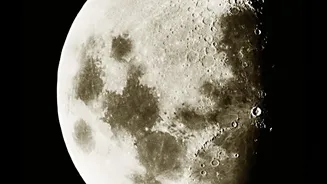
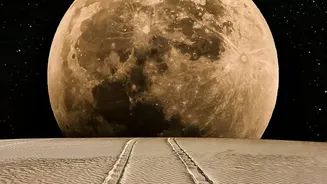
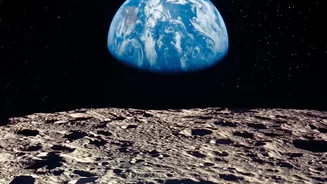
The most famous example of this phenomenon is the 'Moon Illusion'. For thousands of years, people have observed that the moon appears enormous when it's near the horizon but seems much smaller when it's high in the sky. Photographs prove the moon is the same size in both positions, so it's purely a perceptual illusion. When the moon is low, your brain sees it alongside trees, buildings, and mountains. Compared to these familiar objects, the moon appears massive. Your brain interprets it as being very far away—behind those terrestrial objects—and concludes it must be huge to appear that size at such a distance. But when the moon is high overhead, it's isolated in the empty sky. With no context, your brain perceives it as smaller, just like that airplane.
It's an Efficient Feature, Not a Flaw
It’s easy to think of this as a flaw in our perception, but it’s actually a sign of your brain's incredible efficiency. The visual system is built to make quick, rule-based judgments that are right most of the time. It evolved to navigate a world full of objects on the ground and near the horizon. In that context, using environmental cues for size constancy is a brilliant, energy-saving shortcut. The illusion only becomes apparent in the unusual situation of a solitary object against a blank canvas. It’s a rare edge case in a system that otherwise serves us flawlessly every second of the day. The brain isn't showing you a perfect, camera-like image of reality; it's delivering a useful interpretation based on a lifetime of experience in a terrestrial world.