



The Junkyard Above Our Heads
For over sixty years, humanity has been sending rockets, satellites, and people into space. While these missions have connected our world and expanded our knowledge, they have also left behind a dangerous legacy: space debris. Millions of pieces of junk,
from defunct satellites and spent rocket stages to tiny flecks of paint, are currently circling the Earth at incredible speeds. In Low Earth Orbit (LEO), where a huge number of operational satellites reside, even an object the size of a small nut can impact with the force of a hand grenade. This orbital junkyard poses a significant threat to active satellites that provide everything from GPS navigation and weather forecasting to global communications. Experts have long warned of a potential chain reaction known as the Kessler Syndrome, where collisions create more debris, which in turn leads to more collisions, potentially rendering entire orbits unusable for generations.
Enter the Space Janitors
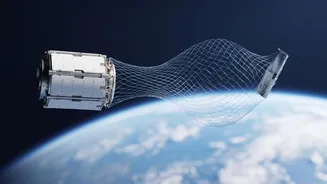
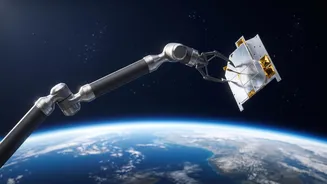
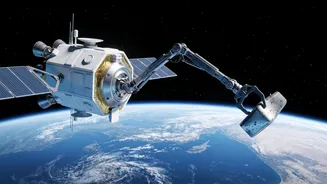
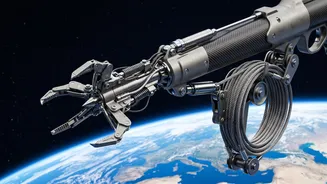
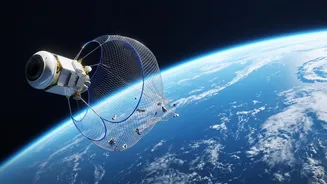
To prevent this cascading failure, space agencies and a growing number of private companies are developing methods for Active Debris Removal (ADR). The European Space Agency (ESA) has been a major proponent, initiating its Clean Space program to fund and develop technologies to tackle the problem. Its upcoming ClearSpace-1 mission, led by Swiss startup ClearSpace, aims to be the first to capture and remove an existing piece of debris from orbit. The mission, now planned for 2028, will use a four-armed claw to grab a defunct ESA satellite and guide it to a fiery end in Earth's atmosphere. This is just one of many concepts being tested. Other promising ideas include giant nets, magnetic capture systems, and robotic arms.
So, What Are Laser Harpoons?
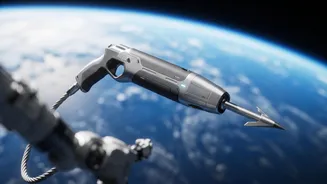
The term “laser harpoon” actually covers two distinct but related concepts. The first is a literal harpoon: a physical projectile fired to spear a piece of debris. A mission called RemoveDEBRIS successfully tested such a device in 2019. Developed by Airbus, the harpoon fired from a chaser satellite, speared a target plate on a boom, and demonstrated that a tethered projectile could securely capture a piece of tumbling junk. The advantage is its simplicity and speed, making it a robust option for grabbing large, uncontrolled objects like old rocket bodies. The second concept involves using lasers not for capture, but for targeting or propulsion. In this model, a powerful ground- or space-based laser, sometimes called a "laser broom," targets a piece of debris. The intense energy beam vaporizes a tiny part of the object's surface in a process called laser ablation. This creates a small puff of plasma that acts like a micro-thruster, nudging the debris into a new, lower orbit where it will eventually burn up in the atmosphere.
The Companies Behind the Tech
While major agencies like ESA lead large-scale missions, a vibrant commercial sector is emerging to turn debris removal into a viable business. Startups like Japan's Astroscale have already demonstrated key technologies, including using magnets to dock with and service satellites. Companies such as Orbital Lasers and Paladin Space are specifically focused on laser-based and capture technologies. The goal for many of these firms is to offer 'Debris Removal as a Service' (DRaaS), where satellite operators can hire them to clear out specific threats or decommission old satellites safely. Partnerships are forming, like the one between U.S.-based Portal Space Systems and Australia's Paladin Space, to combine maneuverable spacecraft with advanced capture payloads, aiming for their first commercial launches around 2027.
The Road Ahead is Not Clear Yet
Despite the promising technology, significant hurdles remain. The sheer scale of the problem is daunting, with millions of untrackable objects. Most current technologies are designed to remove one large object at a time, a process that is both slow and expensive, with single missions costing tens or even hundreds of millions of euros. There are also complex legal and political questions about who has the right to touch, move, or destroy an object that belongs to another country or company. Furthermore, developing autonomous systems that can safely approach and capture a tumbling, non-cooperative target without creating even more debris is an immense technical challenge. However, with the LEO economy booming, the incentive to solve these problems is stronger than ever, driving innovation forward at a rapid pace.