





1. It's Hotter Than Mercury
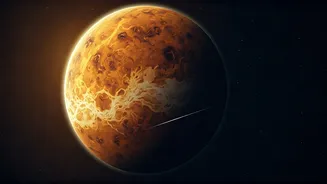
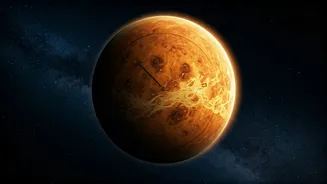
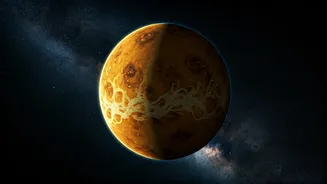
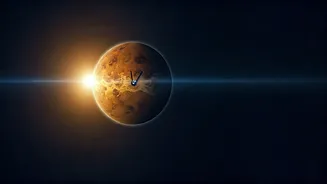
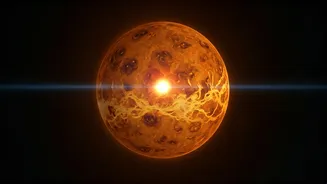
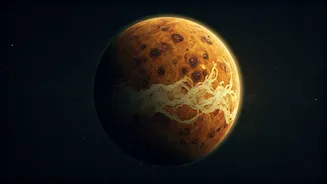
This is the fact that trips everyone up. Mercury is the closest planet to the Sun, so it should be the hottest, right? Wrong. Venus, the second planet from the Sun, holds the title for the hottest planet in our solar system. Its average surface temperature
is a staggering 465° Celsius—hot enough to melt lead. While Mercury faces the Sun’s full blast, it has no atmosphere to trap heat. At night, its temperature plummets. Venus, on the other hand, is wrapped in an incredibly thick, toxic blanket of carbon dioxide. This creates a runaway greenhouse effect, trapping heat and turning the entire planet into a planetary oven that never cools down.
2. The Pressure Will Crush You Instantly
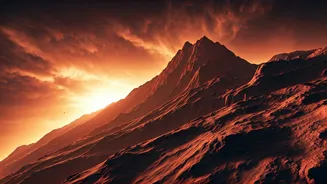
If the heat doesn’t get you, the pressure will. The atmospheric pressure on the surface of Venus is about 92 times that of Earth’s at sea level. To put that in perspective, stepping onto Venus would feel like being 1 kilometre deep in our ocean. No submarine, let alone a human, could withstand it. This immense pressure is due to its incredibly dense atmosphere, which is almost entirely composed of carbon dioxide. The few probes that have successfully landed on Venus, like the Soviet Venera landers, survived for only a couple of hours before being cooked and crushed into silence.
3. A Day on Venus is Longer Than a Year
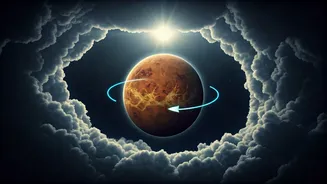
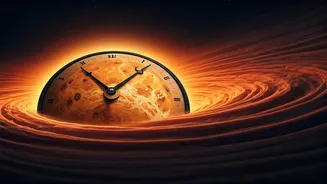
Here's a mind-bender for you. Venus takes approximately 243 Earth days to complete one rotation on its axis (a Venusian day). However, it only takes about 225 Earth days to orbit the Sun (a Venusian year). Yes, you read that right: its day is longer than its year. To make things even weirder, Venus spins backwards. On Earth, the Sun rises in the east and sets in the west. If you could see through the thick Venusian clouds, you would see the Sun rise in the west and set in the east. Scientists believe a massive collision with an asteroid or another planet-sized object early in its history may have knocked it off-kilter, reversing its rotation.
4. It Rains Sulphuric Acid
The clouds of Venus aren't made of water vapour like Earth's. They are thick, swirling layers of sulphuric acid. This creates a perpetual, gloomy yellow haze. While it does technically 'rain' sulphuric acid in the upper atmosphere, the surface is so hot that the acid rain evaporates long before it ever reaches the ground. This phenomenon, known as 'virga,' means the corrosive showers never actually touch down. So, while you wouldn't be dissolved by acid rain on the surface, you'd already be incinerated and flattened by the heat and pressure.
5. It Was Once Possibly Habitable
This is perhaps the most fascinating and terrifying reality of all. Scientific models suggest that for billions of years, Venus might have been a very different world. It could have had a shallow ocean and surface temperatures suitable for life as we know it. It was, in many ways, a true twin to early Earth. But something went catastrophically wrong. The leading theory is that intense, prolonged volcanic activity pumped massive amounts of carbon dioxide into the atmosphere. As the Sun grew brighter over eons, it triggered a runaway greenhouse effect that boiled away the oceans and transformed the planet into the inferno we see today.