



A Cosmic Masterpiece of Ice
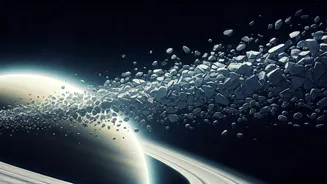
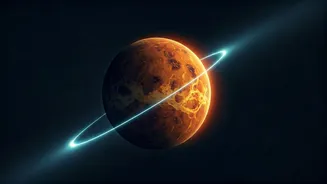
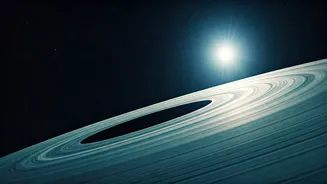
From a distance, Saturn's rings look like solid, smooth discs, like a vinyl record circling a giant planet. But get closer, and this illusion shatters. The rings are not solid at all. Instead, they are a colossal, sprawling system made up of countless
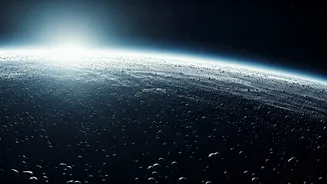
individual particles of ice and rock, all orbiting Saturn at incredible speeds. The vast majority of this material—about 99.9%—is pure water ice. The rest is a sprinkling of rocky material and dust, which gives the rings their subtle variations in colour. The size of these particles varies dramatically. Some are as fine as dust, while others are the size of small pebbles. The most common particles are around the size of a snowball. But scattered throughout are also much larger chunks, some as big as a car, and a few behemoths that could be described as small mountains, stretching a kilometre across. All together, this material forms a system that is incredibly wide—stretching up to 282,000 kilometres from the planet—but astonishingly thin, with a vertical thickness of only about 10 metres in most places. This incredible thinness is why the rings can seem to disappear when viewed edge-on from Earth.
A Tale of Cosmic Destruction
For centuries, astronomers debated the origin of Saturn's rings. Were they leftover material from the formation of the solar system, or did they form later? Thanks to data from missions like Voyager and, most importantly, the Cassini spacecraft which orbited Saturn for 13 years, we now have a leading theory. The rings are young. Surprisingly young. Instead of being 4.5 billion years old like Saturn itself, evidence suggests the rings are likely only 100 to 200 million years old. This means they appeared long after the dinosaurs went extinct on Earth. The most probable origin story is a violent one. Scientists believe that a large, icy moon—or perhaps several smaller ones—once orbited Saturn. This ancient moon, which some have nicknamed 'Chrysalis', strayed too close to the planet. It crossed a critical boundary known as the Roche limit, the point at which a planet's tidal gravitational forces are stronger than the moon’s own gravity holding it together. Saturn's immense gravity tore the moon apart, shattering it into billions of icy pieces that then spread out to form the magnificent rings we see today.
The Secret to Their Shine
One of the most striking features of Saturn's rings is their brightness. They reflect so much sunlight that they can be easily seen with even a small telescope from Earth. This brilliance is a direct result of their composition and their relative youth. Because the rings are made almost entirely of pristine water ice, they act like a vast collection of tiny mirrors, reflecting sunlight back into space with high efficiency. If the rings were made of more rock or were much older, they would have collected more dust from micrometeoroid impacts over billions of years. This accumulated dust would have darkened their surface, making them dull and much harder to see, more like the faint, dark rings of Jupiter or Uranus. Their brightness is a tell-tale sign that they haven't been around long enough to get dirty, cosmically speaking.
A Disappearing Act
Here's the most poignant part of the story: Saturn's rings are temporary. While they may seem eternal to us, on a cosmic timescale, they are a fleeting phenomenon. Data from Cassini confirmed that Saturn is slowly destroying its own beautiful rings. The planet’s powerful magnetic field is pulling in a constant stream of ring material, a process scientists call “ring rain.” Charged water particles from the rings are being drawn along magnetic field lines and dumped into Saturn’s upper atmosphere. This process is happening at an astonishing rate—enough to fill an Olympic-sized swimming pool every half an hour. At this rate, scientists estimate that the entire ring system will be gone in about 300 million years, with some more pessimistic models suggesting it could be less than 100 million years. We are lucky to be living in an era when Saturn's rings are near their most spectacular.