



The Problem with an Open Window
On Earth, we exist within a giant, open life support system. The atmosphere provides breathable air, and the water cycle ensures a continuous supply of fresh water. In the vacuum of space, astronauts have none of these luxuries. Early space missions operated
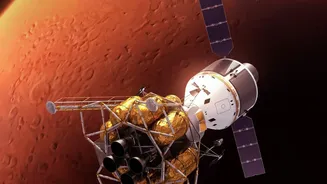
on a simple principle: pack everything you need. This 'open-loop' approach, carrying all necessary oxygen and water, worked for short trips to the Moon. However, the sheer mass of these supplies makes this strategy impossible for long-duration missions. A trip to Mars, for example, could last two to three years. Carrying enough water and air for a crew for that long would be prohibitively heavy and expensive to launch.
The ISS: A Partially Closed System
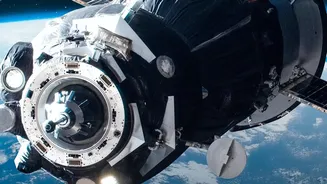
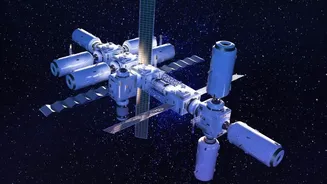
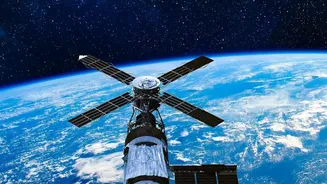
The International Space Station (ISS) represents the first major step towards solving this problem. Its Environmental Control and Life Support System (ECLSS) is a marvel of engineering, designed to reclaim and recycle resources. The system captures moisture from astronauts' breath and sweat, as well as wastewater from showers and hygiene, and even urine. Through a sophisticated process of filtration and purification, it can recover over 90% of the water on board. The water produced is often cleaner than tap water on Earth. Similarly, the ECLSS scrubs carbon dioxide exhaled by the crew and uses electrolysis to split water molecules into breathable oxygen and hydrogen.
Why the ISS Model Isn't Enough for Deep Space
While the ISS's system is incredibly advanced, it is not fully self-sufficient. It is a 'partially closed' loop. Some water is still lost, and key components need to be replaced or serviced via regular resupply missions from Earth. For a habitat on the Moon or a spacecraft journeying to Mars, this reliance on Earth is a critical weakness. A round trip to Mars is so long that a rescue or resupply mission would be impossible. Furthermore, the systems must be incredibly reliable, able to operate without failure for years at a time. A system that is 90% or even 94% efficient sounds good, but over a three-year mission, that small shortfall becomes a catastrophic deficit. That's why the goal for deep-space missions is to achieve nearly 100% recycling efficiency.
Closing the Loop: The Future of Life Support
A 'closed-loop' system is one that can indefinitely regenerate resources with minimal or no external input. This means recycling virtually every molecule. For air, this involves not just removing carbon dioxide but also converting it back into oxygen. Systems like the Sabatier reactor, already tested on the ISS, combine CO2 with hydrogen (a byproduct of oxygen generation) to create water and methane. The water can then be split again to create more oxygen. For water, new technologies like the Brine Processor Assembly are being tested to extract the last usable drops of water from the concentrated waste left over by current urine processors, pushing water recovery rates towards the 98% target deemed necessary for a Mars mission.
Beyond Machines: The Role of Biology
Future deep-space habitats may go a step further by incorporating bioregenerative systems. This involves using living organisms, like plants and algae, to complement the mechanical systems. Plants are natural experts at closing the loop: they absorb carbon dioxide, release oxygen through photosynthesis, and purify water through transpiration. They also, of course, produce food. Integrating compact hydroponic or aeroponic farms into a habitat's life support system could provide a sustainable source of food, fresh oxygen, and psychological benefits for the crew. While still in development, these hybrid systems, blending reliable machinery with the efficiency of nature, represent the ultimate goal for sustainable life beyond Earth.