






The Hidden Cost of Reaching
Reaching for your phone, grabbing a stapler, or twisting to retrieve a file might seem like harmless, minor movements. But when these actions are repeated dozens of times a day, every day, they create what are known as repetitive strain injuries (RSIs).
These disorders affect your muscles, nerves, and tendons, and can lead to persistent pain, numbness, stiffness, and weakness in your upper body. Think of it like a slow-drip of water on a stone; each individual movement is small, but the cumulative effect can cause significant wear and tear. Factors like awkward postures, repetitive tasks, and even the force required to perform an action contribute to the risk of developing these musculoskeletal issues.
Understanding Your 'Reach Zones'
The key to preventing this strain is a core ergonomic principle: the reach zone. Imagine three zones fanning out from where you sit. The first is your primary reach zone, an area you can comfortably access just by moving your forearms, keeping your elbows close to your body. This space, roughly 20-40 cm from your body, is premium real estate. The second, or secondary zone, is reachable by extending your arm from the elbow. The third, or tertiary zone, requires you to lean forward or twist your torso to reach. The fundamental rule of ergonomic organization is to match an item's frequency of use to its zone. Constant-use items belong in the primary zone, frequent-use in the secondary, and infrequent-use in the tertiary.
How to Audit Your Desk Setup
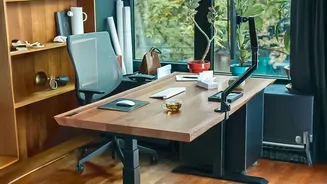
Take a moment to sit at your desk and perform a quick audit. Your keyboard and mouse should be your primary focus. Place them directly in front of you where your hands naturally fall, allowing your elbows to remain close to your body and your wrists to stay straight. Your monitor should be about an arm's length away, with the top of the screen at or just below eye level to keep your neck in a neutral position. Now, consider other items. Is your phone, which you might answer 20 times a day, in the primary or secondary zone? It should be close enough that you don't have to lunge for it. What about your water bottle, notepad, or pen? Any item you touch multiple times an hour should be within easy reach without a full arm extension.
Applying the Principle Beyond the Office
These ergonomic principles are not just for office workers. The same logic applies to any space where you perform repetitive tasks. In the kitchen, for example, frequently used items like your favourite cooking oil, salt, and go-to pan should be stored on the counter or in a front-row cabinet, not buried in the back. Heavy items like a stand mixer should be kept at waist height to avoid straining your back when lifting. In a workshop, the tools you use most often should be on a pegboard or in a top drawer, not at the bottom of a heavy toolbox. By consciously organizing your environment based on frequency of use, you reduce thousands of unnecessary, strain-inducing movements throughout your week.
Small Changes Lead to Big Relief
You don't need to completely overhaul your entire home or office overnight. The goal is to make small, incremental changes that become lasting habits. Start with your desk. Spend five minutes moving your most-used objects into your primary reach zone. Notice how it feels. The next day, tackle another small area. Encouraging better habits also involves taking regular breaks. Even with a perfect setup, sitting in one position for hours is not ideal. Get up, walk around, and do simple stretches to ease muscle tension. Combining a well-organized space with regular movement is the most effective strategy for preventing the chronic aches and pains that can arise from our daily routines.