



The Springtime Water Crisis
For farmers in Ladakh, spring is a season of paradox. It is the crucial time for sowing crops like barley and apples, but it is also when water is most scarce. The region receives very little rainfall and has historically depended on meltwater from snow
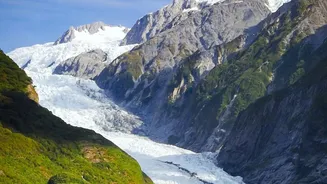
and glaciers for irrigation. Due to climate change, this natural cycle is breaking. Glaciers are receding to higher altitudes and melting later in the summer, while winter snows are becoming less reliable. This creates a critical dry period in April and May, leaving farmers without the water they need to plant their fields, threatening their livelihoods and the region's food security.
A Glacial Idea Takes Shape
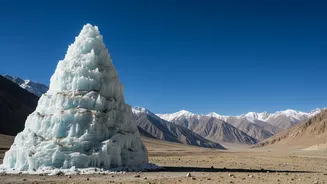
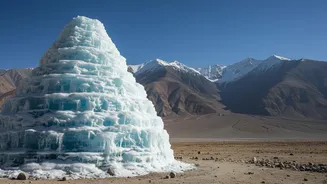
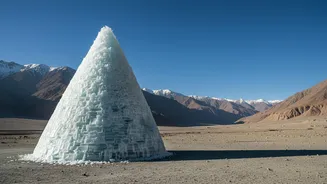
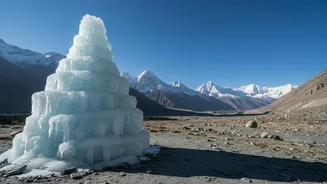
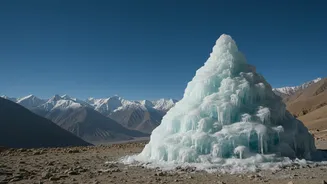
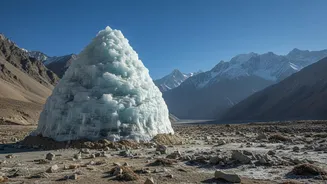
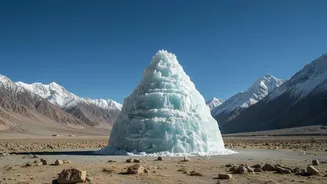
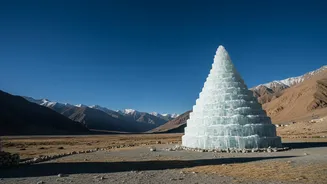
The solution, first pioneered in 2013 by Ladakhi engineer and innovator Sonam Wangchuk, was inspired by a simple observation: ice can survive well into the summer if it remains in the shade. Wangchuk, through his NGO, the Students' Educational and Cultural Movement of Ladakh (SECMOL), re-imagined earlier concepts of artificial glaciers. Instead of creating flat, horizontal ice fields which had a large surface area exposed to the sun, he decided to go vertical. Using basic high-school geometry, he theorised that a cone shape would offer the minimum surface area to the sun for a given volume of water, allowing the ice to last much longer. He named these conical ice mountains 'ice stupas' because of their resemblance to traditional Buddhist monuments common in the region.
The Science of Building Ice
The genius of the ice stupa lies in its elegant simplicity; it requires no pumps, no electricity, and no heavy machinery. The entire system works on gravity. A pipe is laid from a glacial stream at a higher altitude, running downstream to the village. At the chosen location, the pipe is directed vertically upwards. Because water naturally maintains its level, the pressure from the elevation difference forces it up and out of a sprinkler at the top, creating a geyser-like spray. During the frigid winter nights, when temperatures are well below zero, this fine mist of water freezes almost instantly as it falls. Layer by layer, the ice accumulates around a basic frame, growing throughout the winter into a towering cone that can be over 100 feet tall and store millions of litres of water that would have otherwise flowed away unused.
From Frozen Spire to Green Fields
The true magic of the ice stupa becomes apparent in the spring. As the sun gets stronger and temperatures rise, the stupa begins to melt—precisely when farmers need water for irrigation. This slow, steady release of water provides a reliable source for fields throughout April and May, bridging the critical gap until the natural glacial melt begins in June. The first prototype, built in 2014, successfully stored 150,000 litres and lasted until mid-May, proving the concept worked. Since then, dozens of ice stupas have been built across Ladakh, collectively providing tens of millions of litres of water, helping to green the desert and ensure better harvests for local communities.
Challenges and Future Horizons
While the concept is simple, execution requires skill and effort. The construction is labour-intensive and involves risks, like climbing the growing ice structure to adjust the framework. Furthermore, efficiency can be a challenge, as a significant portion of the sprayed water can flow away without freezing. To address this, automated systems are now being tested that use sensors for temperature and humidity to adjust the water flow, optimising ice creation and conserving water. The success of ice stupas has gained global attention, with similar projects being tested in other mountain regions, from the Swiss Alps to Uzbekistan. This Ladakhi innovation is not just about water; it's a powerful symbol of community-led climate adaptation.