




An Unexpected Lunar Encounter
This wasn't a planned mission, but rather a fortunate accident of celestial mechanics. The object was the four-tonne upper stage of a Falcon 9 rocket that launched in January 2025, carrying lunar landers for commercial companies. After completing its
primary mission, the stage was left in a chaotic orbit. The combined gravitational pulls of the Earth, Moon, and Sun eventually guided it onto a collision course. Initially identified by independent astronomers, its trajectory was later confirmed: a 100% chance of impact. Though technically an accident, scientists quickly mobilized to turn this uncontrolled crash into a planned observation experiment.
Why The Excitement Over a Crash?
For lunar scientists, a high-speed impact from a known object is a golden opportunity. Slamming into the surface at over 8,700 km/h, the rocket stage acts like a probe, excavating a new crater. This violent event kicks up a plume of material from beneath the lunar soil, or regolith. By studying this ejected cloud with spectrometers, scientists can analyze the Moon's composition without ever landing a drill. It’s a chance to hunt for compelling materials like water ice, which was famously discovered using a similar, but intentional, impact mission by NASA in 2009. These events provide invaluable data on the geology of the impact zone, the behaviour of ejecta, and the structure of the lunar surface itself.
The Search for a New Scar
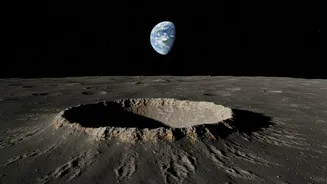
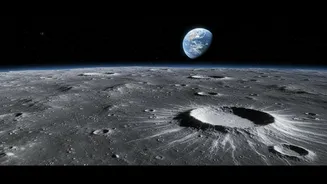
The impact itself, happening on the sunlit side of the Moon, was not expected to be visible from Earth with the naked eye. Instead, the focus was on the aftermath. Both professional observatories and space-based assets like NASA's Lunar Reconnaissance Orbiter (LRO) and South Korea's Danuri spacecraft were tasked with observing the event. The goal was twofold: to try and spot the plume of dust and debris, which some models predicted could tower dozens of kilometers high, and to locate the new crater. By taking before-and-after images of the impact zone near Einstein Crater, orbiters can provide a clear view of the new scar on the lunar landscape.
Lessons from Past Impacts
This isn't the first time a human-made object has struck the Moon. During the Apollo missions, stages were intentionally crashed for seismic studies. More recently, in 2022, a rocket body, believed to be from a Chinese mission, left a surprising and unique double crater on the far side of the Moon. That event puzzled scientists because a typical rocket stage, with its engine at one end, should only create a single crater. Each impact, planned or otherwise, adds to our understanding. The 2022 crash offered insights into the object's mass distribution, while the 2009 planned LCROSS mission confirmed water ice at the lunar south pole. This latest Falcon 9 impact continues that legacy, providing a new data point using a modern commercial rocket body.
A New Era of Lunar Science and Litter
The event serves as a key moment for science, but also as a stark reminder of a growing problem: space junk. As more public and private missions venture to the Moon, the amount of hardware left in orbit or on the surface is increasing. This specific crash highlights the need for better end-of-life protocols for spacecraft components in deep space. While this particular piece of debris proved scientifically useful, future uncontrolled impacts could pose a hazard to sensitive instruments or even future lunar bases. Scientists see this as an opportunity to study those risks and develop better models for tracking and mitigating them as humanity prepares to establish a sustained presence on the Moon.