



A Planet’s Chemical Fingerprint
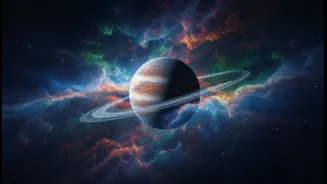
Think of an atmosphere as a planet's fingerprint. Its chemical makeup tells a detailed story. The atmospheres of gas giants like Jupiter are mostly hydrogen and helium, reflecting the primordial gas of the early solar system from which they formed. By
contrast, rocky planets like Earth, Venus, and Mars have secondary atmospheres, formed later by processes like volcanic outgassing. Comparing these different atmospheric compositions helps scientists piece together how various planets formed and why they turned out so differently. For instance, while Venus and Earth are similar in size, Venus’s dense carbon dioxide atmosphere led to a runaway greenhouse effect, offering a cautionary tale for planetary evolution.
The Science of Starlight and Shadows
Astronomers can't just scoop up a sample of an exoplanet's air. Instead, they use a clever technique called transit spectroscopy. When a planet passes in front of its host star from our point of view, a tiny amount of starlight filters through its atmosphere. The gases in the atmosphere absorb specific wavelengths, or colors, of this light. By analyzing the starlight with instruments called spectrographs, scientists can see which colors are missing and identify the exact atoms and molecules present, like water, methane, or carbon dioxide. These absorption patterns act as a unique chemical barcode, revealing the atmospheric composition of worlds hundreds of light-years away.
Revisiting a Planet's Birth
An atmosphere doesn't just reveal what a planet is like now; it contains clues about its entire life story. The ratio of different elements, such as carbon to oxygen, can tell astronomers about the original materials in the planetary disk where the planet was born. For example, a high abundance of heavy elements (anything other than hydrogen and helium) might suggest the planet formed in a region rich with icy or rocky solids. Furthermore, the presence—or absence—of an atmosphere on a rocky planet can provide clues about the history of its host star. Powerful stellar radiation can strip a planet of its atmosphere over billions of years, a process scientists can model to understand a planet's long-term evolution.
The Search for Habitability and Life
One of the most exciting aspects of studying exoplanet atmospheres is the search for signs of life. The presence of water vapor is a key marker for habitability, suggesting conditions might be right for liquid water on the surface. Beyond that, scientists look for 'biosignatures'—gases that could be produced by living organisms. On Earth, the large amount of oxygen is a direct result of life. For exoplanets, the simultaneous presence of gases that wouldn't normally coexist, like methane and oxygen, could be a strong indicator of biological activity. However, scientists must be careful to rule out non-biological sources, or 'false positives,' making the search a complex puzzle.
A New Era with the Webb Telescope
The James Webb Space Telescope (JWST) has revolutionized the study of exoplanet atmospheres. Its powerful infrared instruments can detect faint chemical fingerprints with unprecedented detail, revealing a full menu of atoms and molecules. JWST has already provided stunningly detailed portraits of distant worlds, detecting water, sulfur dioxide, and signs of active chemistry. It can probe the skies of everything from 'hot Jupiters' to smaller, rocky planets, testing theories of planet formation and evolution. While finding a definitive sign of life remains a future goal, the telescope is providing a torrent of data that is rewriting our understanding of the diverse worlds that populate our galaxy.