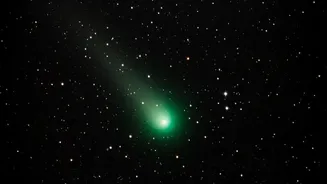







In the vast, dark expanse beyond Pluto, astronomers have spotted something new and unusually bright. Designated 2026 ED138, this celestial object is now the subject of intense investigation as scientists race to determine its size, orbit, and ultimate
status.
A Landmark Discovery
The discovery of 2026 ED138 was made by Matthew Holman, an astrophysicist at the Harvard & Smithsonian Center for Astrophysics, on October 13, 2026. He was combing through data gathered earlier in the year by the powerful Vera C. Rubin Observatory in Chile, which began a 10-year survey of the sky in 2025. The new observatory is uniquely capable of imaging the entire southern sky every few days, revealing faint, moving objects that previous surveys might have missed. When 2026 ED138 appeared in the data, its brightness suggested it was something significant. Holman's initial reaction was one of 'excited disbelief', immediately prompting checks to ensure it wasn't a data error. Further analysis by colleagues confirmed the finding, locating the object in archival images stretching back over a decade, which helped to precisely map its journey.
Is It an Asteroid or a Dwarf Planet?
While the headline term 'asteroid' is often used for any space rock, 2026 ED138's characteristics place it in a more exclusive category. It is a trans-Neptunian object (TNO), meaning its orbit lies beyond that of Neptune. More importantly, its estimated size makes it a strong candidate for being a dwarf planet. A key requirement for a dwarf planet is that it must be massive enough for its own gravity to pull it into a nearly round, or spherical, shape. Initial estimates place the diameter of 2026 ED138 between 600 and 1,500 kilometers (about 370 to 930 miles). If the higher-end estimates are proven correct, it would be among the largest such bodies ever found in the outer solar system, potentially joining the small, recognized group of dwarf planets that includes Pluto, Eris, Ceres, Haumea, and Makemake. However, scientists caution that further infrared observations are needed to confirm its exact size and official status.
Mapping a Distant Orbit
Currently, 2026 ED138 is located about 46 astronomical units (AU) from the sun—one AU is the distance between Earth and the sun. This places it farther out than Pluto, which averages about 40 AU from the sun. The object follows a long, elliptical path, taking roughly 283 years to complete a single orbit. Its orbit is also highly inclined, tilted at about 25 degrees relative to the main plane of the solar system where most planets orbit. This 'hot' classical orbit suggests that its path was likely disturbed long ago by gravitational interactions with Neptune. Despite its great distance, this object is not considered a threat to Earth. Its orbit keeps it firmly in the frigid outer reaches of the solar system, far from the inner planets.
The Global Sky-Watching Network
The discovery of 2026 ED138 highlights the growing power of our planetary defense and sky-surveying capabilities. Organizations like NASA's Planetary Defense Coordination Office (PDCO) and international collaborators fund and operate a global network of observatories to find, track, and characterize near-Earth objects and more distant bodies. Using advanced telescopes on the ground and in space, these programs constantly scan the skies for moving objects. Once a new object is detected, its position is reported to the Minor Planet Center, which catalogs it and helps coordinate followup observations to calculate a precise orbit. This systematic approach not only enriches our understanding of the solar system's formation but also serves as an early warning system for any object that could potentially pose an impact risk to Earth.