





For centuries, understanding the root causes of diseases has been a slow, painstaking process. Now, a new artificial intelligence model from Google is providing a glimpse into a future where we can map the complex machinery of life at incredible speed.
Meet Google's New Biological Oracle
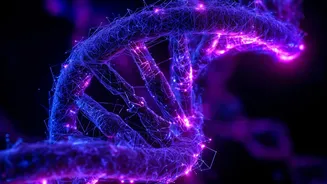
The latest breakthrough from Google's AI labs, including DeepMind and Isomorphic Labs, is a model called AlphaFold 3. It builds on its revolutionary predecessor, AlphaFold 2, which stunned the scientific world by accurately predicting the 3D shapes of proteins—the microscopic machines that perform most tasks inside our cells. But AlphaFold 3 goes much further. It doesn't just see proteins; it predicts how they interact with all the other critical molecules of life, including DNA, RNA, and the small molecules that make up many drugs. This provides a dynamic, holistic view of cellular systems, moving from a static parts list to a detailed blueprint of how everything fits and works together.
Why Molecular Interactions Matter
Think of the inside of a cell as a bustling city. Proteins are the workers, DNA is the central library of instructions, and RNA molecules are the messengers carrying those instructions. For this city to function, all these components must interact perfectly. Disease often strikes when these interactions go wrong. A faulty protein might not bind correctly to DNA, or a crucial cellular switch might get stuck in the 'on' or 'off' position. Until now, mapping these millions of interactions has been incredibly slow and expensive, often requiring years of lab work for a single molecular complex. AlphaFold 3 can generate a highly accurate prediction of these complex structures in a matter of seconds, giving scientists a powerful tool to spot the molecular missteps that lead to illness.
A 'Google Maps' for Disease
The core of many diseases, from cancer to autoimmune disorders, lies in these faulty molecular handshakes. By accurately modeling how a genetic mutation might alter a protein's shape and its interactions, AlphaFold 3 helps researchers pinpoint the exact mechanism of a disease. For example, the model can show how a virus spike protein interacts with human antibodies, offering critical insights for developing vaccines and treatments. Researchers at Isomorphic Labs, a Google sister company focused on drug discovery, are already using the AI to understand how to approach new disease targets that were previously considered unreachable. It acts like a high-definition map of the biological world, allowing scientists to zoom in on the specific problem areas that cause sickness.
Supercharging the Hunt for New Drugs
Understanding what's broken is the first step toward fixing it. The ultimate goal is to design new medicines, and this is where AlphaFold 3's potential truly shines. Drug discovery involves finding a molecule (a 'ligand') that can bind to a specific target protein and alter its function. AlphaFold 3 is reported to be 50% more accurate than the best previous methods at predicting these crucial drug-like interactions. This could dramatically accelerate the process, allowing researchers to computationally screen thousands of potential drug candidates and identify the most promising ones for laboratory testing. This reduces the time and cost associated with drug development and increases the chances of success in clinical trials.
A Tool, Not a Cure-All
While the excitement is palpable, it's important to frame this breakthrough correctly. AlphaFold 3 is a powerful research tool, not a magic wand that instantly creates cures. The model's predictions are just that—predictions. They provide incredibly strong hypotheses that must still be validated through rigorous laboratory experiments and clinical trials. Furthermore, biology is immensely complex, and a static 3D structure doesn't tell the whole story of a dynamic, living system. However, by pointing researchers in the right direction with unprecedented accuracy, the AI can save years of effort and millions in research funding, freeing up scientists to tackle the next set of challenges on the long road to developing new medicines.