



The Old Problem of Heavy Fuel
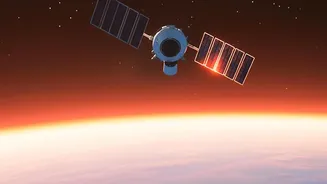
For decades, satellites have relied on chemical propulsion to navigate in space. This involves carrying tanks of chemical fuel and an oxidizer, which are ignited to produce powerful bursts of thrust. This method is effective for big, quick manoeuvres
but comes with a significant penalty: weight. A large portion of a satellite's launch mass is just fuel, needed for tasks like moving into its final orbit and making small adjustments over its lifespan, a process known as station-keeping. This massive fuel requirement directly limits the most important part of the satellite—its payload. The payload is the entire point of the mission, consisting of the instruments, antennas, transponders, and sensors that provide communication services, observe the Earth, or conduct scientific research. More fuel meant less room for the valuable hardware that gets the job done.
A Gentle, Efficient Push
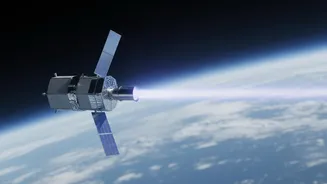
Plasma thrusters, a form of electric propulsion, work on a completely different principle. Instead of a violent chemical reaction, they use electricity, typically generated by the satellite's solar panels, to create and accelerate a stream of ions. Inside the thruster, an inert gas like xenon is given an electric charge, turning it into plasma—the fourth state of matter. An electromagnetic field then accelerates these charged particles and expels them at extremely high speeds. The resulting thrust is very gentle, often compared to the force of a piece of paper resting on your hand. While it can’t provide the powerful kick of a chemical rocket, it can operate continuously for months or even years. This constant, gentle push is incredibly fuel-efficient. This efficiency is measured by 'specific impulse', and plasma thrusters have a specific impulse at least six times higher than traditional chemical systems.
More Room for the Mission
This incredible fuel efficiency is how plasma thrusters 'protect' and even expand payload capacity. Because they need drastically less propellant to achieve the same mission objectives, the weight saved is enormous. For example, a conventional 5,000 kg communication satellite might need over 2,000 kg of chemical fuel. With electric propulsion, that fuel mass can be reduced by hundreds of kilograms. This freed-up mass can be used in one of two ways. First, ISRO can add more payload to a satellite of the same size, such as extra transponders on a communication satellite, making it more powerful and commercially valuable. Second, it can launch a satellite with the same payload capacity but at a much lower overall mass, potentially allowing it to use a smaller, less expensive launch vehicle. Either way, it’s a game-changer for the economics and capabilities of space missions.
ISRO's Leap into Electric Propulsion
ISRO has been strategically moving towards this technology to enhance its capabilities. The space agency has successfully developed and tested its own indigenous Stationary Plasma Thruster (SPT). A significant milestone was the completion of a 1,000-hour endurance test of a 300-millinewton thruster, proving its reliability for long-duration missions. This wasn't just a lab experiment; the test was conducted in a vacuum chamber simulating the harsh conditions of space to measure component erosion and accurately predict the thruster's operational lifespan. The next crucial step is to validate this technology in space. ISRO plans to fly this indigenously developed system aboard its upcoming Technology Demonstration Satellite (TDS-01). This mission will use the plasma thruster for orbit-raising, marking a pivotal moment in India's journey towards self-reliance in this critical space technology.