
A Game-Changing Technological Leap
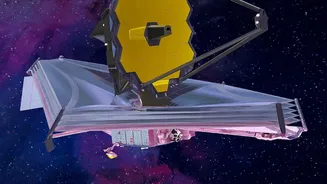
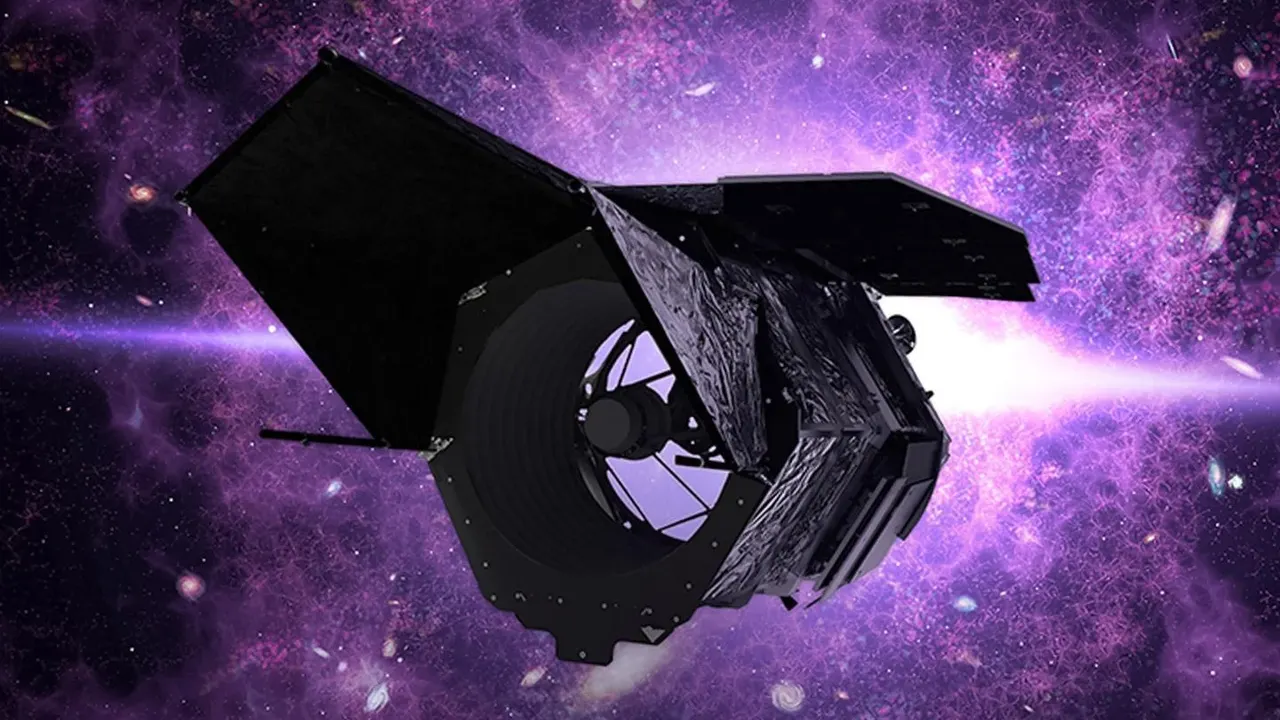
The primary driver of these discoveries is the James Webb Space Telescope (JWST). As the successor to the Hubble Space Telescope, its unparalleled power, particularly in the infrared spectrum, has revolutionised the study of exoplanets. Where previous
telescopes could detect a planet's existence or offer basic hints about its atmosphere, JWST was designed specifically to peer into these distant skies with breathtaking precision. This technological marvel, a multi-billion dollar investment in engineering, is now paying huge scientific dividends. It’s not just finding more planets; it's fundamentally changing our understanding of what planets can be.
How to Read Air From Light-Years Away
Scientists use a technique called transit spectroscopy. When an exoplanet passes in front of its host star from our perspective, a tiny fraction of the starlight filters through the planet’s atmosphere. The gases in that atmosphere absorb light at very specific wavelengths. JWST’s highly sensitive instruments, called spectrographs, can read this filtered light and identify the 'barcode' of missing colors. This chemical fingerprint reveals which atoms and molecules are present, from water vapor to methane. By measuring the dip in starlight as the planet passes behind its star, a technique called secondary eclipse, scientists can also measure the planet's temperature.
A Surprising Chemical Cocktail
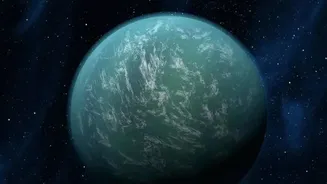
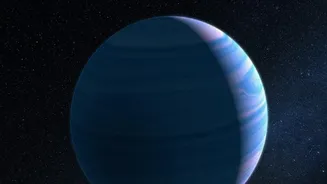
The results have been startling. On K2-18 b, a 'super-Earth' 120 light-years away, JWST found a wealth of methane and carbon dioxide. This supports the hypothesis that it could be a 'Hycean' world—a planet with a potential water ocean beneath a hydrogen-rich atmosphere. Even more intriguingly, initial observations showed a possible detection of dimethyl sulfide (DMS), a molecule that on Earth is predominantly produced by life, like marine phytoplankton. While this is not proof of life, it highlights the incredible chemical complexity present. On other worlds, like the gas giant WASP-39 b, JWST found the first-ever evidence of sulfur dioxide, a byproduct of chemical reactions sparked by the star's intense light.
Challenging the Planetary Playbook
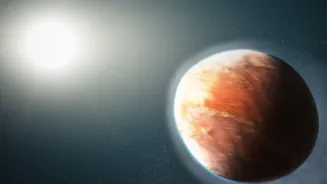
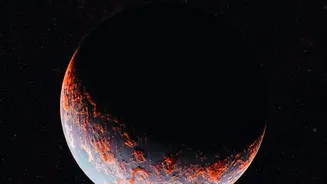
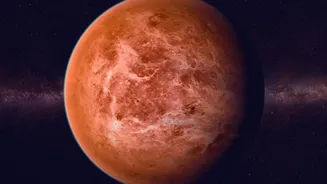
These findings are surprising because they challenge long-held assumptions. Scientists once believed that small, rocky planets orbiting very close to their stars would have their atmospheres blasted away by stellar radiation, leaving them as bare rock. Yet, JWST found strong evidence for an atmosphere on TOI-561 b, an ultra-hot super-Earth so close to its star that its surface is a magma ocean. The presence of a thick, volatile-rich atmosphere on such a world suggests that our models for planet formation and atmospheric retention are incomplete. The galaxy, it seems, is far more creative at building and sustaining worlds than our theories predicted.
What It Means for the Search for Life
Every discovery of a complex molecule brings us closer to answering the ultimate question: are we alone? Molecules like methane and carbon dioxide are crucial ingredients, and their presence in certain ratios can hint at a world's potential habitability. While detecting these molecules is not the same as detecting life, it allows scientists to prioritize which planets are the most compelling targets for further study. The surprising diversity of atmospheres shows that the 'habitable zone' may be broader and more varied than previously thought. We are moving from simply identifying potentially habitable planets to being able to characterize their environments in detail, looking for the chemical imbalances that could be a sign of biological activity.