





Cassini's Grand Finale: A Shower of Mysteries
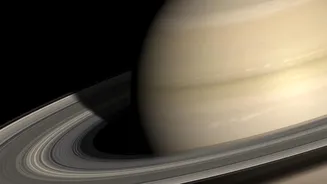
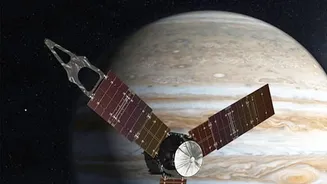
When NASA's Cassini spacecraft ended its 13-year mission in 2017 by plunging into Saturn, it offered a final, spectacular gift. During its last 22 orbits, it flew between the planet and its innermost rings, sampling a phenomenon known as "ring rain."
Scientists had long suspected that material from the rings was falling into the planet, but what Cassini found was a downpour. An astonishing 10,000 kilograms of material was raining down every second. The biggest surprise was the composition of this rain. While the rings are known to be almost entirely water ice, the material falling into the atmosphere was a complex cocktail of methane, carbon monoxide, and other organic compounds, with water making up only about a quarter of the mix. This finding turned previous assumptions on their head, suggesting the rings are far more chemically complex and interactive with the planet than ever imagined.
A System in Constant Flux
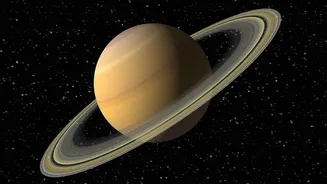
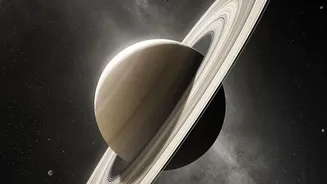
Cassini didn't just find rain; it painted a picture of a dynamic system in constant motion. It revealed that some of Saturn's moons act as shepherds, sculpting the rings, while others, like Enceladus, actively contribute material through icy plumes. It discovered propeller-like features and massive clumps of ice as tall as mountains, shattering the image of a smooth, uniform plane. The mission also reignited a fierce debate about the age of the rings. Data from its final orbits suggested the rings could be relatively young, perhaps only 10 to 100 million years old, meaning they might have formed when dinosaurs still roamed the Earth. This idea that we are lucky enough to be alive in an era when Saturn has its magnificent rings adds a sense of fleeting beauty to the distant planet.
Webb’s Infrared Eyes Offer a New Perspective
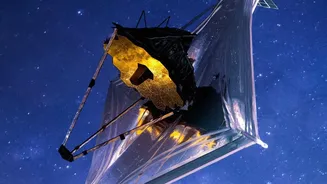
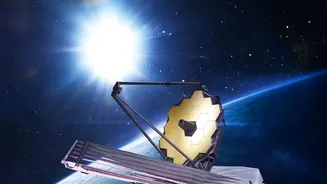
Enter the James Webb Space Telescope (JWST), which began observing Saturn with its powerful infrared instruments, revealing the planet in a completely new light. In Webb's view, Saturn's familiar striped atmosphere appears dark, as methane gas absorbs the sunlight at these wavelengths. This makes the icy, methane-free rings shine with an eerie brilliance, offering an unprecedentedly clear view of their structure. Recent images from 2024 and early 2026, often combined with data from the Hubble Telescope, have provided the most comprehensive view of Saturn to date. These observations have uncovered surprising details in the atmosphere, like large, diffuse structures in the northern hemisphere that don't align with the planet's latitude and lingering remnants of massive storms.
The Latest Surprises from a New Gaze
The collaboration between Webb and Hubble is uncovering even more puzzles. In Webb's infrared images, Saturn's poles glow with a distinct grey-green hue, a feature not seen in visible light. Scientists speculate this could be caused by high-altitude aerosols or even auroral activity, revealing unique chemical processes at play in the polar regions. The new imagery also provides crisp details of the fainter rings and the complex interactions with Saturn's many moons, such as Dione and Enceladus. By observing the planet in different wavelengths, scientists can essentially slice through its atmospheric layers, revealing how powerful winds and deep waves shape the weather patterns we see, including the famous hexagon-shaped jet stream at the north pole. These features are providing a natural laboratory for understanding planetary dynamics under extreme conditions.