



Sugar, Spice, and Everything in Space
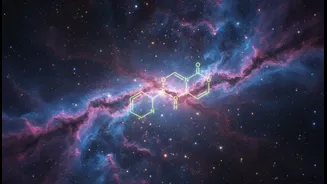
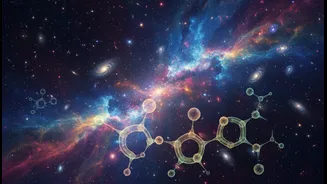
An international team of scientists has announced the first-ever detection of a true sugar molecule in interstellar space. Using powerful radio telescopes in Spain, they peered into a dense molecular cloud named G+0.693-0.027, located roughly 27,000 light-years
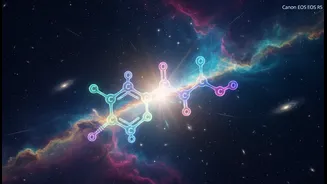
from Earth, near the heart of the Milky Way. There, they found the chemical signature of erythrulose, a four-carbon sugar. If that name sounds vaguely familiar, it’s because erythrulose is a compound found naturally on Earth in things like red raspberries. It's also a key ingredient in many sunless tanning lotions, where it reacts with amino acids in the skin to create a bronze colour. Finding this specific molecule floating in the cold vacuum of space is a remarkable achievement, confirming that compounds crucial for biology can form in the cosmic nurseries where stars and planets are born.
The Building Blocks of Life
So why is finding sugar in space such a big deal? Life as we know it depends on organic molecules. Sugars, along with amino acids, phosphates, and other compounds, are the fundamental building blocks of life. Sugars like ribose form the structural backbone of DNA and RNA, the molecules that carry our genetic code. They are also a primary source of energy for metabolic processes in living cells. For decades, a central question in origin-of-life research has been: where did Earth’s first supply of these vital ingredients come from? One prominent theory is that they didn’t form on Earth at all, but were delivered here from space. Scientists have previously found sugars and other organic molecules in meteorites that have crashed into our planet. This new discovery of erythrulose freely floating in the interstellar medium is the strongest evidence yet that these key ingredients can form in space before being incorporated into the comets and asteroids that eventually seed young planets.
An Ingredient, Not the Final Dish
This is where we must be incredibly careful with our language and our expectations. Finding erythrulose is not the discovery of alien life. It is the discovery of a key ingredient that life requires. Think of it like this: if you find a bag of flour, some sugar, and eggs in a kitchen, you haven't found a cake. You have found the potential for a cake to be baked. Similarly, finding a prebiotic molecule like a sugar is an exciting clue in the search for life beyond Earth, but it is not life itself. Life is an incredibly complex, self-sustaining, and replicating system. A single molecule, no matter how complex, does not meet that definition. The discovery tells us that the raw materials for life are likely common throughout the galaxy. It makes the idea of life emerging elsewhere more plausible, because the universe seems to be stocked with the right ingredients. But the leap from a cloud of cosmic sugar to a living, breathing organism is astronomically large, and we have no evidence that this leap has happened anywhere else.
A Sweeter Understanding of the Cosmos
Beyond its implications for the origin of life, the detection of erythrulose is reshaping our understanding of astrochemistry. It is the largest non-cyclic molecule yet found in interstellar space. Interestingly, scientists found that erythrulose was significantly more abundant than simpler, three-carbon sugars in the same cloud. This challenges the long-held theory that complex molecules in space build up slowly, one carbon atom at a time. Instead, the evidence suggests that erythrulose likely forms when two simpler, two-carbon molecules combine on the icy surfaces of cosmic dust grains. This opens up new possibilities for how even more complex molecules, like the five-carbon sugar ribose (the 'R' in RNA), might form. This discovery gives scientists a new roadmap, encouraging them to search for other sugars and vital compounds that could be hiding in the vast chemical factories between the stars.