
The Search for Another 'Us'
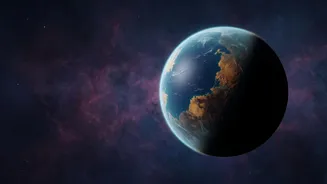
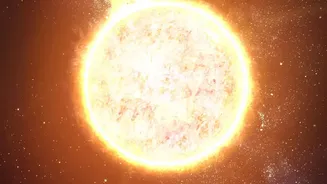
For decades, the search for exoplanets was implicitly a search for another Earth, orbiting another Sun. Our star, a relatively stable, middle-aged G-type star, provides a comfortable baseline. Its habitable zone—the orbital band where temperatures allow
for liquid water—is a key focus for astronomers. We understand this environment best because we live in it. This has led to a focus on finding similar star systems, but science is revealing this may be an overly narrow view. Understanding planet formation requires studying the whole range of stellar and planetary masses. The chemical makeup of a star is also a crucial factor. For instance, gas giant planets are more likely to form around stars rich in elements like iron, whereas smaller, rocky worlds can form around stars with more diverse compositions, suggesting they may be more common than we thought.
Life Around a Turbulent Red Dwarf
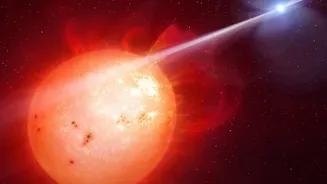
Red dwarfs, or M-dwarfs, are the most common type of star in the Milky Way. They are much smaller, cooler, and dimmer than our Sun, meaning a planet must orbit incredibly close to stay warm enough for liquid water. This proximity, however, comes with severe challenges. Many of these planets are likely 'tidally locked,' with one side in permanent daylight and the other in perpetual night. More menacingly, red dwarfs, especially when young, are prone to violent flares, blasting their nearby planets with high-energy X-rays and ultraviolet radiation that can strip away an atmosphere and boil off water. Recent studies show that extreme tidal forces could 'bake' two-thirds of these planets, rendering them sterile. Yet, their sheer abundance and incredibly long lifespans—trillions of years, compared to our Sun's 10 billion—make them impossible to ignore in the search for life.
Planets of the Titans
On the other end of the spectrum are the massive, brilliant O- and B-type stars. These stellar giants are incredibly hot and live fast, dying in spectacular supernova explosions after only a few million years. For a long time, it was believed that their intense radiation would blow away the planet-forming material in their surrounding disks, making it nearly impossible for large planets to form. However, the discovery of a giant planet orbiting the massive binary star system b Centauri challenged this notion. This planet exists in an incredibly wide orbit, suggesting that planet formation models need to be revised for these extreme environments. Studying these rare systems helps astronomers understand how planets can form under the most destructive and chaotic conditions imaginable, pushing the boundaries of our knowledge.
Phoenix Worlds at the End of Time
What happens after a star like our Sun dies? It collapses into a white dwarf—a dense, cooling core. Any nearby planets would likely be destroyed during the star's red giant phase. Yet, astronomers are discovering that planets can exist even here. Some may be hardy survivors that were kicked into distant orbits, but others appear to be 'second-generation' or 'phoenix' planets. Recent evidence points to a planet that may have formed from the material the star cast off as it died—a world literally born from the ashes of its parent star. Astronomers identified this by detecting unusual heavy elements in the white dwarf's atmosphere, which are byproducts of a star's death. Finding these reborn worlds not only tells us about the ultimate fate of planetary systems but opens up a completely new, and unexpected, place to look for planets.