


Sifting Through the Cosmic Haystack
Modern telescopes are incredibly powerful, creating a data tsunami. Instruments on missions like the James Webb Space Telescope can generate petabytes of information, far too much for human scientists to manually inspect. This is where AI shines. NASA
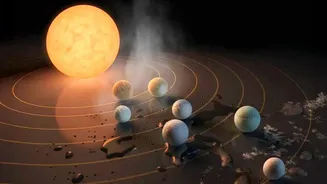
uses deep learning systems, such as ExoMiner, to sift through data from telescopes like Kepler to find new planets orbiting distant stars. These AI models are trained to recognise the tiny, tell-tale dips in starlight that occur when a planet passes in front of its star. By automating this pattern-recognition task, AI has helped identify hundreds of new exoplanets, dramatically accelerating the search for worlds beyond our solar system.
Giving Rovers a Mind of Their Own
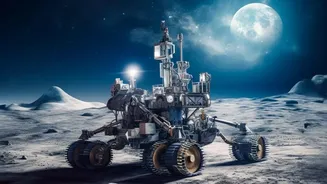
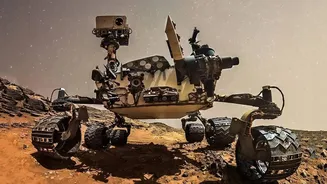
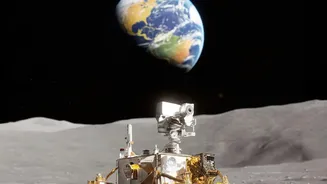
When a rover is exploring Mars, there's a communication delay of up to 20 minutes each way, making real-time remote control impossible. Early rovers required human planners on Earth to meticulously map out every move. Today, AI grants rovers like Perseverance a significant degree of autonomy. In late 2025, Perseverance completed the first-ever drives on Mars that were entirely planned by an AI called Claude. The AI analyzed high-resolution orbital imagery and terrain data to identify hazards and plot a safe, efficient route without human input. This allows the rover to cover more ground, make decisions on the fly, and spend less time waiting for instructions from 140 million miles away, making missions more efficient and productive.
Designing the Next Generation of Spacecraft
AI's role isn't limited to analysing data or driving rovers; it's also changing how NASA designs the hardware for its missions. Using a process called "generative design," engineers at NASA's Goddard Space Flight Center are creating lighter and stronger spacecraft components. A human designer sets the basic requirements for a part, such as where it connects and what forces it must withstand. The AI then generates thousands of potential designs, evolving them to find the most efficient and robust shape possible. The results often look organic or "alien," but they can be up to two-thirds lighter than human-designed parts while being significantly stronger. This weight saving is critical, as every kilogram launched into space is incredibly expensive.
An Early Warning System for Space Weather
The Sun, while essential for life, can also unleash powerful solar flares and coronal mass ejections. This "space weather" can threaten satellites, power grids on Earth, and the safety of astronauts. Predicting these events is a major challenge. In partnership with IBM, NASA has developed an AI model named Surya to provide an early warning. Trained on nearly a decade of solar imagery from NASA's Solar Dynamics Observatory, Surya analyzes the Sun's complex magnetic fields to spot patterns that often precede a major flare. The model aims to improve forecasting and potentially double the warning time, giving operators crucial hours to protect vital infrastructure from the Sun's fury.