






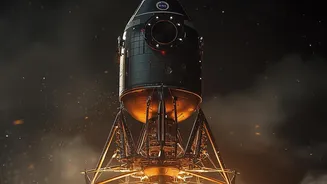
Gaganyaan: India's Human Spaceflight Ambition
The Gaganyaan programme is India's landmark mission to demonstrate human spaceflight capability by launching a crew of three astronauts to an orbit of 400 kilometres for a three-day mission and bringing them back safely to Earth. Successfully completing
this mission will make India the fourth nation in the world, after the US, Russia, and China, to have an independent capability for human spaceflight. The programme represents a monumental leap for India's scientific and technological prowess, with astronaut safety being the absolute highest priority.
The Final Gauntlet: Uncrewed Safety Tests
Before putting human lives on the line, every single component and system must be tested to its limits. This is the current phase of the Gaganyaan mission, where a series of uncrewed flights and ground tests are designed to validate the technology that will protect the astronauts. ISRO is deliberately simulating worst-case scenarios to ensure that even if something goes wrong, the crew can return safely. These tests are not just a dress rehearsal; they are the exhaustive, systematic process of earning the right to fly, with thousands of ground tests already completed to ensure every system is perfect.
Inside the Critical Safety Trials
Several key systems are undergoing intense qualification tests. One recent series of trials focused on three critical moments of the mission. The first is the Crew Module Up-righting System (CMUS), which uses gas-inflated floats to ensure the capsule stays upright after splashing down in the sea, a crucial step for a safe recovery. The second test validated the umbilical separation, ensuring the Crew Module disconnects cleanly from the Service Module before re-entry. The third confirmed the module's structure can withstand the powerful forces when the apex cover, which protects the parachutes, is jettisoned. These tests push the hardware well beyond expected flight loads to guarantee its integrity.
Mastering the Descent: Parachute Systems
A safe return is as important as a successful launch. The Gaganyaan capsule's deceleration system relies on a complex sequence of ten parachutes of four different types to slow it down for a gentle splashdown. ISRO, in collaboration with DRDO and the Indian Air Force, has been conducting a series of Integrated Main Parachute Airdrop Tests (IMAT). In these tests, a simulated Crew Module is dropped from an aircraft at high altitude to validate the deployment sequence and structural integrity of the parachutes. Starting with smaller drogue parachutes to stabilize the capsule, the sequence ends with three large main parachutes to ensure a safe landing speed.
The Role of Vyommitra and the Path Forward
The first uncrewed flight, designated G1 and targeted for late 2026, will serve as a full-system test in space. Aboard this mission will be Vyommitra, a humanoid robot developed by ISRO. Vyommitra will simulate human functions, allowing ISRO to gather vital data on how the Crew Module's life support systems perform and what conditions the astronauts will experience. Following a series of uncrewed validation flights, the first crewed Gaganyaan mission is anticipated to launch, with current timelines pointing towards 2027.