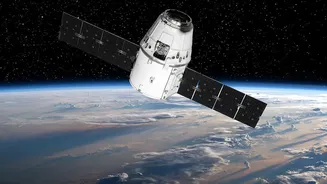







Elon Musk’s vision for the future of artificial intelligence is not on Earth, but in orbit. He proposes that the immense energy and space required for next-generation AI make a move off-planet not just possible, but logical and necessary.
The Terrestrial AI Traffic Jam
The artificial
intelligence boom is putting unprecedented strain on our planet's resources. Modern AI models require vast data centres that consume enormous amounts of electricity and water for cooling. In many developed regions, the demand for power is outstripping the grid's capacity, leading to multi-year waiting lists for new connections and pushback from local communities concerned about environmental impact and rising utility costs. Elon Musk argues this terrestrial bottleneck is unsustainable. He has repeatedly stated that as AI's computational needs grow exponentially, Earth simply doesn't have enough power or physical space to keep up, creating what he calls a high 'pitchfork level' for data centres on the ground.
Why Process Data in Orbit?
The solution, according to Musk and a growing number of tech visionaries, is to move these energy-intensive operations into space. The logic rests on two key advantages: power and cooling. In specific orbits, solar panels can receive near-continuous sunlight, unhindered by weather or the day-night cycle, generating significantly more power than the same panels on Earth. Secondly, while cooling in a vacuum is a complex engineering challenge, space offers a massive advantage: a constant-temperature backdrop of nearly absolute zero. This allows for heat to be radiated away without consuming the vast quantities of water required by terrestrial data centres. This approach could transform AI infrastructure from a planetary burden into a scalable, off-world resource.
An Enabler, Not A Service Provider
The headline's distinction is crucial: Musk’s vision isn't necessarily for SpaceX to sell AI services directly. Instead, SpaceX would act as the great enabler, providing the foundational infrastructure that other companies would use. This is analogous to how companies build fibre optic networks but don't control all the content that flows through them. SpaceX's role would be to provide the key components: launch capability with its reusable rockets like Starship to get the hardware into orbit affordably; the physical satellite platforms; and the data connectivity through its Starlink laser-link mesh network. The actual AI processing would be done by others, potentially including Musk's own xAI, but also competitors like Google, which has already launched test satellites with SpaceX for its 'Project Suncatcher' orbital AI research.
The Orbital Obstacles
Despite the compelling vision, the path to orbital data centres is littered with significant hurdles. The primary challenge is cost. Even with reusable rockets, launching the immense weight of servers and cooling radiators into space is incredibly expensive—potentially costing multiples more than an equivalent terrestrial facility. Furthermore, hardware in space cannot be easily repaired or upgraded, a major issue in the fast-evolving AI industry where chips become obsolete in a few years. Finally, there are the physics problems of radiation and heat. Space is filled with radiation that can corrupt data and damage sensitive electronics, requiring expensive 'hardened' components. Efficiently dissipating heat from thousands of processors in a vacuum using radiators is a monumental engineering task that remains largely theoretical at this scale.
The Next Frontier for Computing
Even with the challenges, the push toward space is gaining momentum. Musk has stated that SpaceX, in collaboration with NVIDIA, plans to launch its first 'Starmind' orbital computers in late 2027, with significant volume ramping up in 2028 and 2029. He has boldly predicted that within a few years, it will be cheaper to generate AI compute in space than on the ground. This move represents a fundamental reimagining of where our digital world lives. For years, AI has been used in a limited capacity for space exploration, helping with satellite control and data analysis. But this new paradigm flips the script, positioning space itself as the primary arena for AI's future growth. If successful, it could unlock computational power on a scale previously thought impossible.