






A Policy Shift Opens the Skies
For decades, space was the exclusive domain of the government-run ISRO. But a monumental shift began around 2020, culminating in the Indian Space Policy 2023. This policy was designed to do one crucial thing: open the entire value chain of the space economy
to private companies. It created a clear framework, defining the roles of different bodies. ISRO is now tasked with focusing on advanced research and development, transitioning mature technologies to the private sector. A new autonomous body, the Indian National Space Promotion and Authorisation Centre (IN-SPACe), was established to act as a single-window agency to promote, guide, and authorise all private space activities. This move provides a stable and predictable regulatory environment, giving private players the confidence to invest and innovate.
Meet the New Space Pioneers
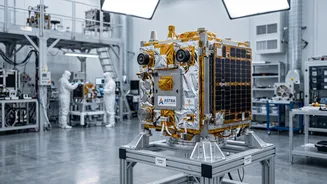
The policy liberalisation has unleashed a wave of entrepreneurial energy. The number of space startups has skyrocketed from just a handful in 2020 to over 400 by 2026. Companies like Skyroot Aerospace and Agnikul Cosmos are at the forefront of developing private launch vehicles. Skyroot made history with Vikram-1, India's first privately developed orbital rocket, which successfully launched in July 2026. Agnikul is pioneering 3D-printed rocket engines, a major innovation in manufacturing. Meanwhile, startups like Pixxel are building constellations of high-resolution Earth-observation satellites, providing AI-powered data analytics for sectors like agriculture and mining. Others, like Dhruva Space, are focusing on building satellites for clients and providing integrated solutions. These companies are attracting significant global investment, signalling strong confidence in their potential.
The Soaring Economic Opportunity
The numbers are staggering. India's space economy, valued at around $9 billion in 2023, is projected to surge to over $40 billion by 2033 and potentially reach $100 billion by 2040. This growth would increase India's share of the global space market from about 2% to a target of 8-10%. The opportunities span the entire spectrum of space activities. The most visible is launch services, with private companies aiming to provide cost-effective solutions for deploying small and medium satellites. Another major area is downstream applications, which involves using satellite data for everything from climate monitoring and disaster management to urban planning and financial services. The manufacturing of satellites, ground station equipment, and various components for the global supply chain also presents a massive opportunity, leveraging India's established manufacturing capabilities.
Navigating the Hurdles Ahead
Despite the optimism, the path forward has challenges. One of the biggest is the intense global competition, particularly from established players with reusable rocket technology, which significantly lowers launch costs. While foreign direct investment rules have been liberalised, there are still caps, especially for launch vehicle companies, which can hamper scaling. Access to capital, especially for long-gestation hardware projects, remains a critical hurdle. Investors are increasingly looking for proven technology and clear commercial roadmaps before committing large sums. There's also a need for more specialised talent in fields like propulsion and avionics, as well as greater access to sophisticated testing infrastructure, much of which is still controlled by ISRO. Aligning policy, funding, and talent development will be key to ensuring these startups can transition from building capabilities to running sustainable businesses.