




In a major step for planetary science, NASA's SPHEREx telescope has detected carbon dioxide in the atmospheres of brown dwarfs. This finding is more than a chemical footnote; it is a crucial test of the tools astronomers will use to search for life elsewhere.
Cosmic Misfits Get Their Moment
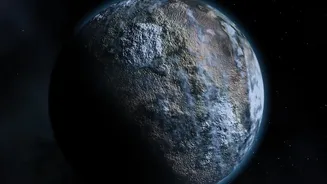
Imagine an object stuck in limbo, more massive than Jupiter but not quite a star. That's a brown dwarf. Often called 'failed stars', they form from collapsing clouds of gas and dust, just like stars do, but never gain enough mass to ignite the stable hydrogen fusion that makes stars shine. Instead, they smolder with leftover heat from their formation, slowly cooling and dimming over billions of years. Despite their name, they aren't actually brown; depending on their temperature, they would likely appear magenta or deep red to our eyes. These lonely wanderers, often floating freely without a host star, are fascinating to astronomers because they serve as a bridge between planets and stars, offering a simpler laboratory to study atmospheric physics.
A New Eye on the Sky
The discovery was made by NASA's SPHEREx space telescope, which stands for Spectro-Photometer for the History of the Universe, Epoch of Reionization, and Ices Explorer. Launched in 2025, its primary mission is to create a comprehensive map of the entire cosmos in near-infrared light, which is invisible to the human eye. By scanning the full sky multiple times, SPHEREx helps astronomers tackle huge questions, like how the universe began and how galaxies evolved. A valuable 'side project' for the mission is spotting and analyzing thousands of dim objects like brown dwarfs. Using a technique called spectroscopy, the telescope splits the infrared light from these objects into a spectrum, like a prism making a rainbow. By looking for dark gaps in this spectrum, scientists can identify the chemical fingerprints of specific molecules that have absorbed the light.
A Telltale Atmospheric Signature
In a recent study, scientists used SPHEREx to analyze 37 nearby brown dwarfs and found clear evidence of not just carbon dioxide, but also water, methane, and carbon monoxide. Finding any molecule is a technical achievement, but CO2 is a particularly valuable tracer for understanding how a celestial body formed and evolved. Its presence provides vital clues about the temperature, chemistry, and composition of these strange atmospheres. The SPHEREx data showed that while no two brown dwarfs are exactly alike, there are clear chemical trends. The findings are helping astronomers build better models of how atmospheres behave on worlds outside our solar system, although the complexity of these 'goth planets', as one scientist called them, still poses challenges to existing theories.
A Crucial Dress Rehearsal
The real excitement behind this discovery lies in what it means for the future. The same spectroscopic techniques used to find CO2 on these relatively simple brown dwarfs are exactly what astronomers will use to probe the atmospheres of Earth-sized planets orbiting distant stars. Successfully detecting these molecules on a brown dwarf is a proof-of-concept, confirming our instruments and methods are up to the task. Think of it as a dress rehearsal for one of the biggest scientific quests of our time: the search for habitable worlds and potential biosignatures—gases like oxygen or methane that could hint at the presence of life. Finding carbon dioxide is a key milestone on that journey, demonstrating a capability that will be essential for characterising smaller, rocky planets that are much harder to study.