
The Wobble Method
One of the most successful ways to find a new world is to watch for its gravitational effect on its parent star. A star with a planet doesn't stay perfectly still; it 'wobbles' as the planet's gravity tugs on it while they both orbit a common center of mass.
Think of a large person walking a small, energetic dog on a leash—the person gets pulled around a bit, too. Astronomers detect this wobble by looking at the star's light. As the star moves toward us in its tiny orbit, its light shifts slightly to the blue end of the spectrum; as it moves away, it shifts toward the red. This is called the Doppler effect, and by measuring these tiny, regular shifts, scientists can infer the presence of an unseen planet and even estimate its minimum mass. This technique, formally known as the radial velocity method, was the first successful method for finding exoplanets and is still widely used by ground-based telescopes.
The Cosmic Blink
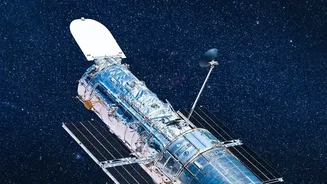
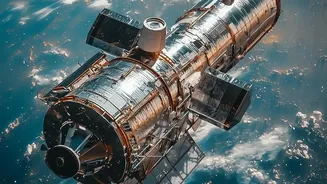
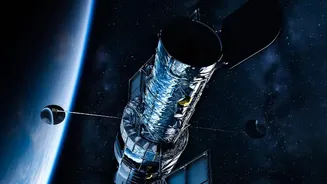
The most productive method for discovering exoplanets is called the transit method. This technique involves monitoring a star's brightness over time. If a planet's orbit happens to be aligned just right, it will pass directly in front of its star from our point of view. When this happens, it blocks a tiny fraction of the star's light, causing a brief, periodic dip in its observed brightness. It’s like noticing a streetlamp dim slightly because a moth flies in front of it. While the dimming is minuscule—for an Earth-sized planet crossing a Sun-like star, it's only about 0.008%—our telescopes are sensitive enough to detect it. Space telescopes like NASA's Kepler mission and its successor, TESS, have used this method to find thousands of planets by staring at huge patches of the sky. The transit method is powerful because it can tell us the planet's size and the length of its orbit.
The Direct Snapshot
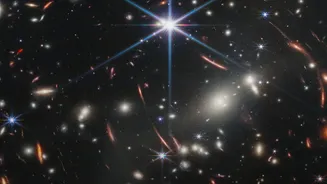
Why not just take a picture? Direct imaging is the most straightforward method in principle, but also the most difficult in practice. The challenge is immense: an exoplanet is incredibly faint compared to the overwhelming glare of its host star. It's often compared to trying to spot a firefly next to a brilliant searchlight from kilometres away. To achieve this, astronomers use advanced instruments called coronagraphs, which are like a sophisticated mask inside a telescope that blocks out the star's light, allowing the faint glow of a nearby planet to become visible. This method works best for large, young, hot planets that are in wide orbits around their stars, as they are brighter and easier to separate from the star's glare. The James Webb Space Telescope (JWST) has pushed this technique to new frontiers, successfully imaging new exoplanets and providing unprecedented detail.
The Gravity Lens
Gravitational microlensing is a method that sounds like it's straight out of science fiction. It uses Albert Einstein's theory of relativity, which shows that gravity can bend spacetime. Here's how it works: if a star with a planet passes almost perfectly in front of a much more distant star from our perspective, its gravity acts like a natural magnifying glass, or lens. This lens bends and focuses the light from the background star, causing it to temporarily brighten. If the foreground star has a planet, the planet's own gravity creates an additional, brief spike in the brightness. These events are extremely rare, depending on a chance alignment of stars, and they don't repeat. However, this method is uniquely powerful for finding planets at great distances, including smaller, Earth-mass worlds and even 'rogue' planets that don't orbit a star at all.