






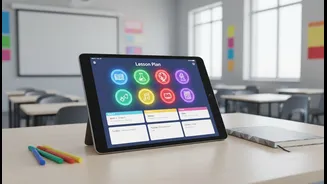


What Are AI Lesson Planners?
At their core, AI lesson planners are software tools designed to act as a teacher's assistant. Instead of starting from a blank page, an educator can input a few prompts—like a topic, grade level, and subject—and the AI generates a structured lesson plan.
This can include learning objectives, activity ideas, materials needed, and even assessment questions. Many platforms are designed to align with specific curriculum standards, including those like CBSE and ICSE. Tools like MagicSchool.ai and Brisk Teaching offer extensive libraries of templates for everything from creating a rubric to drafting a science experiment outline, often integrating directly into existing workflows like Google Docs.
The Primary Benefit: Reclaiming Time
The most celebrated advantage of these platforms is speed. Teachers report that tasks that once took hours, such as creating a full unit plan or generating a set of differentiated worksheets, can now be accomplished in minutes. This automation of routine administrative tasks is crucial. Surveys indicate that Indian teachers using AI tools for lesson planning save several hours each week. This reclaimed time allows educators to shift their focus from paperwork to more impactful activities, like providing individual student support, refining their teaching strategies, or simply avoiding burnout.
Differentiated Learning on Demand
Beyond speed, a significant pedagogical benefit is the ability to easily create materials for diverse learners. India's classrooms are incredibly varied, with students at many different learning levels in a single room. AI platforms like Diffit excel at taking a single source text and instantly generating versions for different reading levels. A teacher can ask an AI to create a simpler explanation for a struggling student, a more challenging problem for an advanced learner, or visual aids for kinesthetic learners, making the goal of personalized instruction more attainable. This directly supports the competency-based learning goals outlined in the National Education Policy (NEP) 2020.
Crucial Caveats and Considerations
Despite the benefits, adopting AI is not without its challenges. A major concern is the 'digital divide,' as many schools, particularly in rural areas, lack the necessary internet connectivity and devices. There's also the risk of AI-generated content containing factual errors, biases, or being too generic and lacking local context. Educators must treat AI-generated plans as a first draft, not a final product. Over-reliance can also stifle a teacher's own creativity and critical judgment. Furthermore, data privacy is a significant concern, requiring schools to ensure student and teacher data is protected.
The Teacher Remains at the Centre
Ultimately, experts agree that AI in education is a tool to support teachers, not replace them. The empathy, critical thinking, and human connection a teacher provides are irreplaceable. The most effective use of AI is when a skilled educator uses it to handle the logistical heavy lifting. The teacher's role evolves to that of a curriculum designer and facilitator who uses their professional judgment to adapt, refine, and implement the resources AI provides. For Indian classrooms, this means selecting tools with multilingual support, mobile-first design, and content relevant to the local context. Platforms developed in India, like Teachmint, are often built with these specific realities in mind.