




A Landmark Funding Round
Eka Robotics, a startup focused on advanced robotic manipulation, has officially announced a $150 million Series A funding round. The investment was co-led by prominent venture capital firms Andreessen Horowitz (a16z) and F-Prime, with continued support
from seed investors. This massive infusion of capital has pushed the company's valuation to an impressive $1.45 billion, signalling strong investor confidence in its mission to bridge the gap between AI software and real-world physical tasks. The funding is earmarked to help Eka scale its technology, expand customer deployments, and accelerate its go-to-market strategy, starting with some of the hardest problems in robotics.
Beyond Mimicry: Mastering Physics
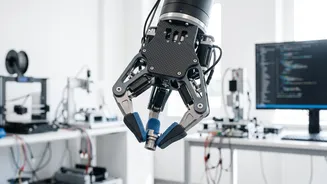
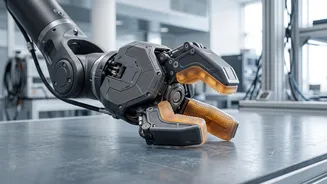
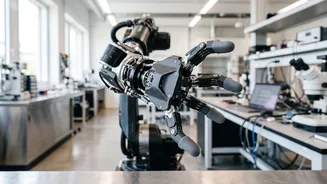
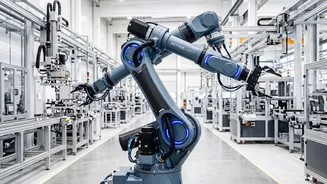
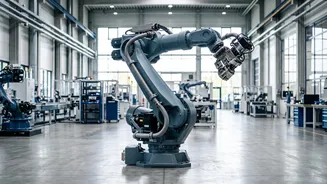
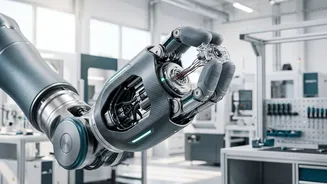
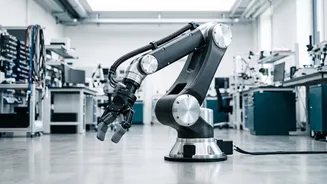
For decades, robots have excelled in highly structured environments like automotive assembly lines, where tasks are repetitive and predictable. The real challenge lies in creating robots that can handle the variability of the physical world—from picking delicate fruit to assembling complex electronics. Eka's core innovation is its 'Vision-Force-Action' (VFA) model. Instead of just mimicking human actions, Eka's AI learns to master physics. It combines camera vision with a sense of touch, using a dense network of force sensors in its gripper. This allows the robot to build an 'intuition' about how to handle objects, adjusting its grip and force in real-time to avoid crushing a berry or to securely handle an unfamiliar component.
Training Robots in Simulation
A key part of Eka's strategy is its use of large-scale reinforcement learning within physics simulations. Instead of needing thousands of hours of real-world trial and error, which is slow and expensive, Eka can generate vast amounts of robotic experience in a simulated environment in just minutes. By varying objects, environmental conditions, and physical parameters in the simulation, the AI model learns a general understanding of manipulation that can then be transferred to a physical robot. This approach helps overcome the 'sim-to-real' barrier, a long-standing problem in robotics, making it a more scalable and capital-efficient path to creating a versatile foundation model for physical work.
Superhuman Performance and Industrial Impact
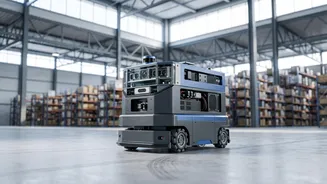
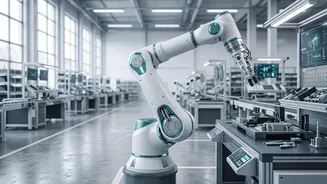
The results of this approach are already showing remarkable promise. Eka claims its robots can pick and place around 1,500 objects an hour with over 95% accuracy, significantly outperforming a human worker who might handle about 600 objects in the same timeframe. One of the lead investors noted that the technology is already exceeding human performance on certain dexterous tasks, with the potential to achieve superhuman levels across many more in the near future. The initial applications are focused on pick-and-place logistics and complex wire handling, with pilots already underway with several undisclosed industrial customers. These capabilities are crucial for India's growing manufacturing and e-commerce sectors, which are increasingly turning to automation to boost productivity and competitiveness.
The Future of Work in India
While founded by a team with roots at MIT, Berkeley, and Google DeepMind, the implications of Eka's technology for India are profound. The country's industrial robotics market is expanding rapidly, with a compound annual growth rate projected at over 14%. However, robot density remains low compared to global averages, indicating a massive opportunity for growth. High upfront costs and a skills gap have traditionally been barriers for many Indian businesses, especially smaller enterprises. By developing AI that makes robots more versatile and easier to deploy, companies like Eka could lower these barriers. This funding is not just a vote of confidence in one startup; it represents a major step toward a future where intelligent, adaptable robots become a core part of India's industrial landscape, from automotive plants to warehouse floors.