
A New Look at Our Star
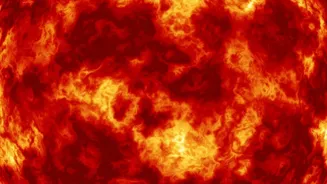
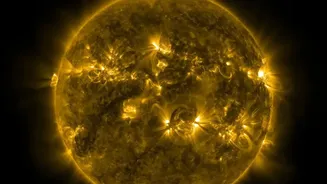
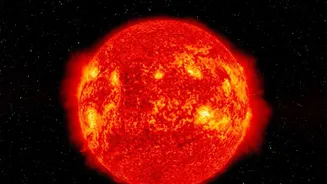
Using the world's largest solar telescope, the Daniel K. Inouye Solar Telescope in Hawaii, astronomers have captured the Sun's surface in staggering new detail. The images, published in the journal Nature in August 2026, reveal incredibly small, swirling
plasma vortices at the edges of solar granules—the bubbling, cell-like structures of hot gas that cover the Sun. These newly visualized details are like finally seeing individual brushstrokes in a masterpiece that was previously viewed from a distance. The achievement is being compared to spotting a feature the size of a coin from over 100 kilometers away, giving scientists an unprecedented window into the fine mechanics of our star.
What Are These Plasma Vortices?
The Sun isn't a solid ball; it's a superheated mass of plasma, a state of matter where electrons are stripped from their atoms. This plasma is constantly in motion, driven by intense heat from the core and governed by powerful magnetic fields. The newly seen vortices are evidence of something called Kelvin-Helmholtz instabilities. This is a fundamental process in fluid dynamics that happens when two fluids, or in this case plasmas, flow past each other at different speeds. This creates a shear force, causing the boundary between them to ripple and curl into wave-like vortices, much like how wind blowing over water creates waves on a lake. While the theory was well-known, seeing it happen on such a small and detailed scale on the Sun is a groundbreaking first.
Unlocking Solar Secrets
These small-scale waves are more than just a beautiful cosmic phenomenon; they are crucial clues for solving some of the biggest puzzles in solar physics. One major mystery is the coronal heating problem: why the Sun's outer atmosphere, the corona, is millions of degrees hotter than its surface. Researchers believe that energy is transferred from the surface to the corona, and these tiny, energetic vortices could be a key part of that process. According to the Max Planck Institute for Solar System Research, these vortices demonstrate how minute processes can significantly shape the nature of our star, twisting magnetic field lines and building up energy much like a coiled spring.
The Link to Space Weather
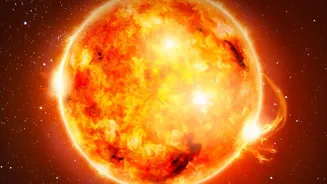
The buildup and sudden release of this magnetic energy are what drive major solar events like solar flares and coronal mass ejections (CMEs). These are massive eruptions of plasma and radiation from the Sun that travel out into space. When directed at Earth, they are the cause of 'space weather.' While the newly observed vortices are small, understanding how they contribute to the Sun's overall energy budget is critical. By studying how these tiny twists in the magnetic field add up, scientists can build more accurate models of how and when the Sun might unleash a larger, more powerful eruption.
Why It Matters on Earth
Better prediction of space weather is a major goal for scientists, and it has very real-world consequences. A powerful solar storm aimed at Earth can have significant effects. It can disrupt satellite operations, affecting everything from GPS navigation to global communications. It can also endanger astronauts in orbit and, in the most extreme cases, induce powerful currents in our power grids, potentially causing widespread blackouts. By providing a more detailed picture of the Sun's fundamental processes, this new discovery is a vital step toward improving our ability to forecast these potentially damaging events and protect our technologically dependent society.