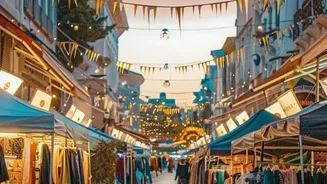






Delhi’s Chandni Chowk has reclaimed its glory, not with more traffic, but with none at all. Its recent transformation into a pedestrian-friendly zone places it in a global conversation about how cities can be designed for people, not just cars.
Chandni Chowk, Delhi: A Heritage Revival
For centuries,
Chandni Chowk has been the chaotic, beating heart of Old Delhi. Built in the 17th century by Emperor Shah Jahan's daughter, Jahanara, it was a grand commercial artery. But over time, it became a tangle of traffic, overhead wires, and congestion. The recent redevelopment project has changed all that. A 1.3-km stretch from the Red Fort to Fatehpuri Masjid is now a no-traffic zone for most of the day, from 9 a.m. to 9 p.m. The goal was to decongest the area and create a safe, walkable environment that honours its Mughal-era heritage. Paved with red sandstone and granite, the new streetscape features wide footpaths, benches, and dedicated lanes for non-motorised vehicles, with all utility lines now hidden underground. The transformation aims to reinforce the street's role as a market, a public gathering space, and a ceremonial route, re-establishing a visual and historical continuity that was lost to traffic.
Strøget, Copenhagen: The Commercial Pioneer
When talking about pedestrian streets, Strøget in Copenhagen is often the first name that comes to mind. It’s not just one street but a network of interconnected car-free thoroughfares stretching 1.1 km, making it one of Europe's longest pedestrian shopping areas. When it was converted in 1962, the idea was revolutionary and controversial. Many local merchants feared that a lack of cars would mean a lack of customers. The opposite proved true. Today, Strøget attracts around 80,000 visitors daily in the summer, blending high-end luxury brands like Prada and Hermès with popular high-street stores. Its success demonstrated that prioritizing people could be a massive commercial boon, influencing countless other cities to create their own car-free zones and proving that walkability is good for business.
Rue Mouffetard, Paris: A Market with Medieval Charm
Long before pedestrianisation became a modern urban planning trend, there was Rue Mouffetard in Paris. One of the city's oldest streets, its path follows an ancient Roman road. Affectionately called 'la Mouffe' by locals, this narrow, cobbled street in the Latin Quarter is less a tourist attraction and more a living, breathing neighbourhood market. It's where Parisians have come for centuries to buy fresh produce, cheese, bread, and meat from vendors who line the street, particularly on its pedestrianised lower half. The street largely escaped the grand rebuilding of Paris by Baron Haussmann in the 19th century, which is why it retains its medieval character. It showcases how a pedestrian street can be the centre of community life, a place not just for commerce but for daily social interaction, a role Chandni Chowk has also played for centuries.
The Shambles, York: A Walk Through History
If you want to feel like you’ve literally walked into the past, The Shambles in York, England, is the place to go. Arguably the best-preserved medieval street in the world, some of its buildings date back to the 14th century. Its name comes from 'fleshammels', the Anglo-Saxon word for the shelves on which butchers displayed their meat. For centuries, this was a street of butchers, and its unique architecture reflects that. The timber-framed buildings overhang the narrow street, a clever design to shelter the meat on display from direct sunlight before the age of refrigeration. In some parts, you can almost touch both sides of the street at once. While no butchers remain, walking down The Shambles is an immersive historical experience, showing how a street's design can tell the story of its past function much like the havelis and historic architecture of Chandni Chowk tell Delhi's story.
Hosier Lane, Melbourne: A Canvas for the Streets
Not all famous pedestrian streets are defined by commerce or ancient history. Some, like Hosier Lane in Melbourne, are defined by art. Since the late 1990s than this cobbled bluestone laneway has become a worldrdrenowned destination for street art. What was once a neglected service alley transformed into a dynamic,
open air gallery where graffiti stencils and murals create a constantly changing visual landscape Artists work freely and the art is in a constant state of flux with new works regularly painted over old ones This free to paint zone has become a major tourist attraction demonstrating that a pedestrian space can become a vibrant cultural hub While controversial at times with debates over vandalism versus art Hosier Lane proves that giving streets back to people can foster creativity and turn a simple laneway into a landmark.