



Why Europa? A Water World in Disguise
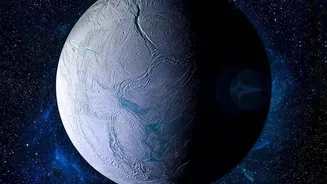
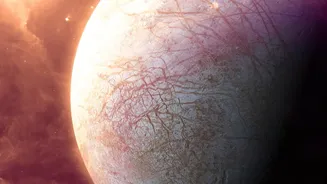
Slightly smaller than Earth's moon, Europa has captivated scientists for decades. Its surface is one of the smoothest in the solar system, a vast expanse of water ice crisscrossed with reddish-brown cracks. This unusually young surface suggests it is constantly
being resurfaced, hinting at a dynamic world below. The main attraction lies beneath this frozen shell. Strong evidence from previous missions suggests Europa hides a global ocean of salty liquid water, containing twice as much water as all of Earth's oceans combined. This ocean is kept from freezing solid by tidal heating—a constant gravitational tug-of-war with the colossal planet Jupiter that flexes the moon's interior and generates heat. Where there is liquid water, energy, and the right chemical ingredients, there is a potential for life, making Europa a top target in our solar system.
Meet the Interplanetary Detective
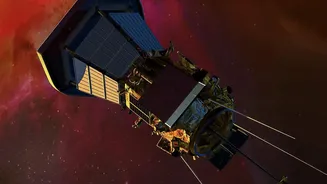
The Europa Clipper is the largest interplanetary spacecraft NASA has ever built. Launched in October 2024 aboard a SpaceX Falcon Heavy rocket, the probe is now on a long and winding 5.5-year journey to the Jupiter system. Its path isn't a straight line; it's a carefully choreographed cosmic dance. It performed a gravity-assist maneuver around Mars in March 2025 and is scheduled for another around Earth in December 2026. These flybys use the planets' gravity to slingshot the spacecraft, giving it the incredible speed needed to reach Jupiter by its expected arrival in April 2030. Once there, it won't orbit Europa directly due to the intense radiation trapped by Jupiter's magnetic field. Instead, it will enter a long, looping orbit around Jupiter, performing nearly 50 close flybys of Europa over four years, dipping as low as 25 kilometers above the surface to gather data.
A Toolkit for Assessing Habitability
The Clipper's main goal is not to find life directly, but to determine if Europa's ocean is habitable. To do this, it carries a sophisticated suite of nine scientific instruments. Instruments like the Europa Imaging System (EIS) will capture high-resolution images of the surface geology, while an ice-penetrating radar will try to measure the thickness of the icy shell and confirm the ocean's existence and depth. Other tools, like mass spectrometers (MASPEX) and a dust analyzer (SUDA), are designed to taste the moon's faint atmosphere and any material ejected from its surface. Scientists are particularly hopeful they might fly through plumes of water vapor erupting from the ocean below, as suggested by Hubble observations. Analyzing the chemical makeup of this material could reveal the composition of the hidden ocean and search for "biosignatures"—complex organic molecules that could point to biological processes.
The Search for Life's Ingredients
Life as we know it requires three key things: liquid water, essential chemical elements (like carbon, hydrogen, nitrogen, oxygen), and a source of energy. Europa appears to have all three. Its ocean provides the water. The energy likely doesn't come from the sun, but from the tidal heating and chemical reactions at the seafloor, potentially at hydrothermal vents similar to those on Earth's ocean floors where life thrives in total darkness. The chemical elements, or CHNOPS, may have been delivered by comets or could be leached from the rocky seafloor as water circulates. The Europa Clipper's instruments will investigate all three parts of this habitability puzzle. By studying the surface composition, analyzing the magnetic field to understand the ocean's salinity and depth, and sniffing for organic compounds, the mission will create the most detailed portrait yet of this mysterious world.