





A Tale of Two Moons
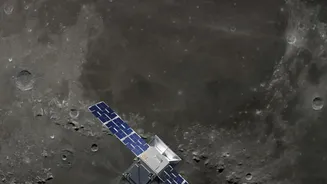
The Moon is tidally locked with Earth, meaning it always presents the same face to us. The side we see, the nearside, is characterized by vast, dark plains of ancient volcanic rock called 'maria'. These cover about a third of its surface. In stark contrast,
the farside, first seen by a Soviet probe in 1959, is almost entirely covered in craters. It's rugged, mountainous, and has a crust that is significantly thicker and geochemically different. This stark difference, known as the lunar dichotomy or asymmetry, has been one of the biggest puzzles in planetary science. Why would one celestial body have two such dramatically different faces?
A Historic Journey to the Hidden Side
Until now, all lunar samples brought to Earth by the Apollo, Luna, and previous Chang'e missions were from the nearside. Our understanding of the farside was based solely on remote sensing data. That all changed with China's historic Chang'e-6 mission. In June 2024, the robotic probe successfully landed in the South Pole-Aitken (SPA) basin, the largest and oldest impact crater on the Moon, and one of the largest in the solar system. The mission collected 1,935.3 grams of rock and soil—humanity's first-ever physical samples from the Moon's hidden hemisphere—and returned them to Earth.
What the Farside Rocks Revealed
Initial analysis of the Chang'e-6 samples, published in journals like National Science Review, has offered surprising insights. Scientists found that the farside soil is a mix of local basalt (volcanic rock) and other materials likely ejected from distant impacts. Geochemically, these samples are very different from their nearside counterparts. They are significantly lower in elements like potassium, thorium, and uranium—a radioactive mix known as KREEP that is abundant on the nearside and produces heat. The farside samples also have a higher concentration of plagioclase feldspar minerals and a lower density, suggesting a more porous structure.
Solving the Asymmetry Puzzle
These findings are helping scientists refine theories about the Moon's formation. One leading hypothesis suggests the asymmetry dates back to the Moon's fiery birth. Shortly after forming, the Moon was much closer to a still-scorching Earth. The intense heat from our planet would have kept the nearside molten for longer, while the farside cooled more quickly. This allowed a thicker crust, rich in elements like aluminum and calcium, to form on the farside. The thinner crust on the nearside made it easier for asteroids to punch through, releasing the lava that formed the dark maria we see today. Another theory suggests the massive impact that created the South Pole-Aitken basin itself played a key role. It would have generated a huge plume of heat that propagated through the Moon's interior, pushing heat-producing KREEP elements toward the nearside and fueling its unique volcanism. The new samples, showing low levels of these elements on the farside, lend weight to these ideas.
Why These Samples Matter for the Future
Understanding the Moon's composition is not just about solving ancient mysteries. It is crucial for the future of space exploration. The South Pole-Aitken basin, where Chang'e-6 landed, is a prime target for future crewed missions, including NASA's Artemis program, because it's believed to hold vast quantities of water ice in permanently shadowed craters. This water could be used for drinking, creating breathable air, and producing rocket fuel, making it a vital resource for a sustained human presence on the Moon. These first farside samples provide 'ground truth' that helps verify remote sensing data and gives mission planners invaluable information for building future lunar bases.