

Meet Roman: The New Cosmic Surveyor
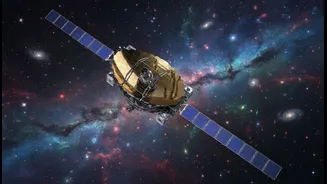
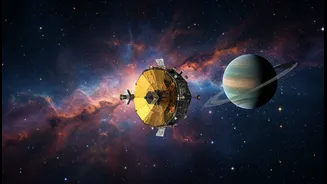
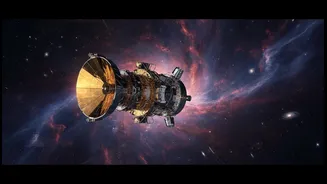
The Nancy Grace Roman Space Telescope, named after NASA's first chief of astronomy, is a flagship mission with a clear and ambitious purpose. While it has a primary mirror the same size as the Hubble Space Telescope—2.4 meters in diameter—its power lies
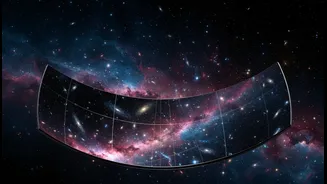
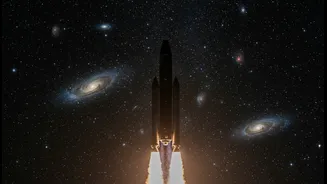
in its extraordinary field of view. Its Wide Field Instrument (WFI) will be able to capture an area of the sky 100 times larger than Hubble can in a single snapshot, while maintaining similar image sharpness. This panoramic capability is what makes Roman a survey telescope, designed not to stare at single objects for long periods, but to rapidly map vast swathes of the universe. The telescope, which recently arrived at Kennedy Space Center in Florida, is in the final stages of preparation for its launch aboard a SpaceX Falcon Heavy rocket.
A Million-Mile Journey to a Special Orbit
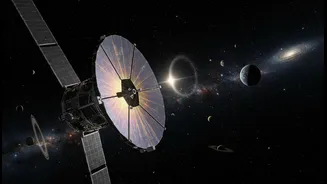
Roman's destination is not just any spot in space. It's heading to a halo orbit around the second Sun-Earth Lagrange point, or L2, approximately 1.5 million kilometers from Earth. This is a special gravitational stability point where the pull of the Sun and Earth balance out, allowing the spacecraft to maintain its position with minimal fuel. Orbiting L2 keeps the Sun, Earth, and Moon behind the telescope, giving it a clear, unobstructed view of deep space. This location also helps keep the telescope's sensitive infrared instruments cold and free from interference, which is crucial for detecting the faint light from distant galaxies and exoplanets. The journey to L2 is a critical first step in its five-year primary mission to explore the dark universe.
Shining a Light on Dark Energy
One of Roman's two primary science objectives is to investigate the mystery of dark energy, the enigmatic force causing the universe's expansion to accelerate. Scientists will use Roman to conduct massive surveys of hundreds of millions of galaxies and thousands of exploding stars called Type Ia supernovae. These supernovae serve as 'standard candles' because their intrinsic brightness is known, allowing astronomers to calculate their distance with high precision. By measuring how the light from these distant galaxies and supernovae is stretched, and mapping their distribution across cosmic time, Roman will help scientists trace the expansion history of the universe. This data is expected to provide a tenfold improvement in the precision of our measurements of dark energy's effects, helping to distinguish between competing theories about its nature.
The Great Exoplanet Census
The telescope’s other main goal is to conduct a vast census of exoplanets, planets outside our solar system. While previous missions like Kepler were incredibly successful, Roman is poised to change the game entirely. Using a technique called gravitational microlensing, Roman is expected to discover thousands of new worlds. This method is sensitive to planets from the outer parts of their solar systems and even 'rogue' planets that don't orbit a star at all—types of worlds that are difficult to find with other techniques. Microlensing occurs when a star or planet passes in front of a more distant star, and its gravity briefly magnifies the background star's light. By staring at the dense star fields in the center of our galaxy, Roman's wide view will catch these fleeting events. Projections suggest Roman could find between 60,000 and 200,000 planets, a haul that would dwarf the entire catalog of exoplanets discovered to date.
A Technology Testbed for Future Discoveries
Beyond its main surveys, Roman will also carry a technology demonstration called the Coronagraph Instrument. This instrument is designed to block the overwhelming glare from a star, allowing astronomers to directly image the faint planets orbiting it. This is an incredibly challenging task, but the Roman Coronagraph aims to achieve a contrast 1,000 times better than previous space-based coronagraphs. While primarily a demonstrator, it will be able to study the characteristics of giant planets. The lessons learned from this instrument will pave the way for future missions, like the planned Habitable Worlds Observatory, which will be designed specifically to find and characterize Earth-like planets around other stars.