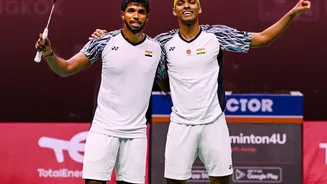








The Weight of the Gold
Winning a gold medal at the Asian Games is a career-defining achievement. Defending it is a legacy-defining trial. When Satwiksairaj Rankireddy and Chirag Shetty step onto the court in Ichinomiya City for the 2026 Games, they will no longer be the challengers;
they will be the hunted. Their victory in Hangzhou was a watershed moment for Indian badminton, a breakthrough that cemented their status as national heroes. But with that status comes immense pressure. Every opponent will be playing their best, eager to topple the reigning kings. The mental fortitude required to absorb that pressure and perform is just as critical as any physical skill, and it represents the first, invisible hurdle on their path to a second consecutive gold.
Evolution of the 'Indian Express'
The duo, affectionately known as 'Sat-Chi', has not been resting on their laurels. Currently ranked firmly within the world's top five, their game has continued to evolve. Their primary weapon remains their terrifying, all-out attack. Opponents have openly described their style as a formidable combination of 'speed-power,' leveraging their height to unleash threatening smashes that can overwhelm any defence. However, recognizing that power alone isn't enough at the highest level, they have worked extensively with coach Tan Kim Her to add layers to their strategy. This includes adopting a more effective side-by-side formation and developing subtler service variations to gain an early advantage in rallies. While their attack is arguably the best on the circuit, they have also acknowledged the need to strengthen their defence, an area where top Korean pairs often have an edge. This commitment to growth shows their awareness that repeating as champions requires a more complete arsenal.
A Field of Formidable Foes
The landscape of men's doubles is a gauntlet, dominated by Asian powerhouses who will all be vying for the top prize. The primary threats are numerous and dangerous. From South Korea, the world number one pair of Kim Won-ho and Seo Seung-jae present a massive challenge. After a dominant 2025 where they won 11 titles, including the World Championships, they have shown some vulnerability in 2026 but remain the team to beat. China’s Liang Wei Keng and Wang Chang are an aggressive, world-class pair capable of matching Satwik-Chirag’s firepower. Not to be outdone, Indonesia's Fajar Alfian and Muhammad Shohibul Fikri bring flair and unpredictability, holding the world number two spot. And then there are the familiar rivals, Malaysia's Aaron Chia and Soh Wooi Yik, a duo against whom Satwik and Chirag have had many tough battles. With the Games being held in Japan, home pairs like Takuro Hoki and Yugo Kobayashi will also have a significant advantage.
The Path to Victory
So, can they do it? The answer is a resounding 'maybe,' and that's what makes it so exciting. A successful title defence will depend on three key factors: fitness, tactical discipline, and mental resilience. The gruelling BWF tour schedule means arriving at the Asian Games healthy and at peak physical condition is half the battle. Tactically, they must demonstrate the evolution of their game, knowing when to unleash their power and when to rely on their improving defensive and net skills to outmanoeuvre opponents. They cannot simply blast their way through every match. Finally, they must embrace the pressure of being defending champions. Their journey to gold in 2023 was built on a fearless, attacking spirit. To win again in 2026, they will need to combine that fire with the ice-cool composure of seasoned champions who have a target on their backs. It will require them to be smarter, more adaptable, and mentally tougher than ever before.