



A Universe of New Worlds
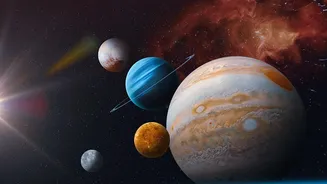
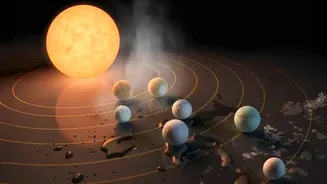
Super-Earths are one of the most common types of planets discovered in our galaxy, yet our own solar system curiously lacks one. These worlds occupy a fascinating middle ground: they are rocky like Earth but significantly larger and more massive. This
size difference raises critical questions. Could they retain a stable atmosphere? Could they host liquid water? Or are they just oversized, barren rocks or, at the other extreme, small gas giants with crushing atmospheres? Until recently, astronomers could detect these planets, but they couldn't learn much about their specific conditions. Understanding them is a key priority, as it helps narrow down the search for habitable environments beyond our own.
Webb's Infrared Advantage
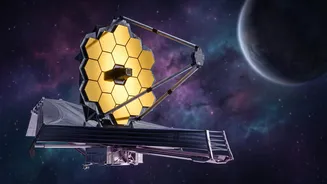
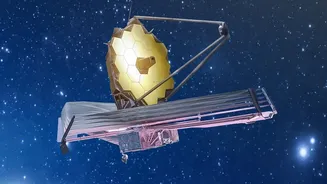
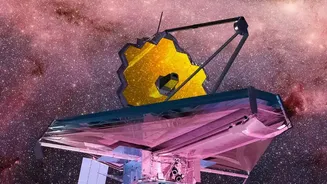
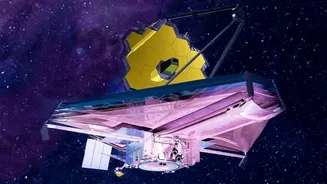
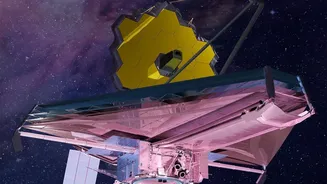
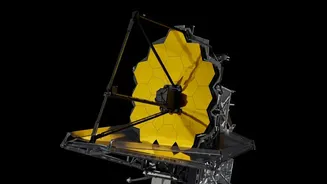
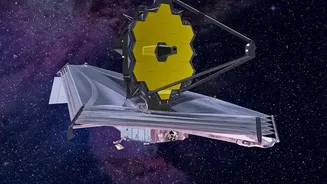
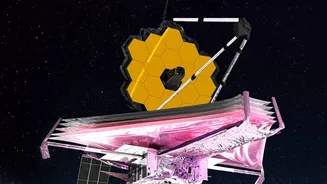
This is where the James Webb Space Telescope (JWST) represents a monumental leap forward. Its power lies in its ability to see the universe in infrared light, which is invisible to the human eye but carries a wealth of information. When a planet passes in front of its star, a tiny fraction of the starlight filters through the planet's atmosphere. Different gases in that atmosphere absorb specific wavelengths of infrared light, leaving a unique chemical fingerprint. By analyzing this light with its spectrographs, Webb can effectively 'read' the composition of a distant world's air. It can also measure the heat radiating directly from a planet, which tells scientists about its temperature and how energy circulates from its permanent day side to its night side.
Case Study: A Molten Lava World's Atmosphere
One of the most stunning recent findings comes from the super-Earth 55 Cancri e, a planet orbiting so close to its star that its surface is likely a molten ocean of magma. Logic suggested that such a hot planet, blasted by intense stellar radiation, shouldn't be able to hold onto an atmosphere. Yet, JWST data tells a different story. The dayside temperature was measured to be significantly cooler than expected if it were just bare rock, suggesting that an atmosphere is distributing heat around the planet. The readings hint at an atmosphere rich in carbon dioxide or carbon monoxide. Scientists believe this isn't the planet's original atmosphere but a 'secondary' one, constantly being replenished by gases bubbling out of the magma ocean below. This shows that even hellish worlds can sustain atmospheres through active geology.
Distinguishing Rock from Gas
The findings on 55 Cancri e, along with similar evidence for an atmosphere around another ultra-hot super-Earth, TOI-561 b, are revolutionary. They challenge old assumptions and demonstrate JWST’s ability to probe the environments of rocky worlds. This capability is crucial for one of the biggest challenges in exoplanet science: distinguishing true, rocky super-Earths from 'mini-Neptunes'. Mini-Neptunes may have a similar size but are covered in a thick, hydrogen-rich atmosphere that would make their surfaces completely inhospitable. By using infrared spectroscopy to identify the gases present, astronomers can finally begin to sort the promising rocky candidates from the gassy ones. While observing a molten planet's atmosphere doesn't point to life, proving the method works is a critical step toward using it on more temperate, Earth-like worlds in the future.