



The Heart of the Empire: B.B.D. Bagh
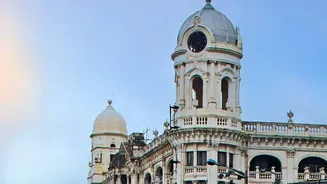
Your journey begins at B.B.D. Bagh, formerly known as Dalhousie Square. This area was the administrative and commercial core of British Calcutta, centred around the historic Lal Dighi water tank. Today, it remains the city's central business district
and holds perhaps the most concentrated collection of colonial-era buildings in India. The square itself is named in memory of three freedom fighters—Benoy, Badal, and Dinesh—who made a daring attack inside the Writers' Building in 1930, a testament to the complex history etched into these streets. To simply walk around the square is to witness the evolution of a global city.
The Writers' Building: A Crimson Fortress of Power
Dominating the northern side of the square is the iconic Writers' Building with its striking red brick facade. Originally constructed in 1777 by Thomas Lyon to house the junior clerks, or 'writers', of the East India Company, it was Calcutta’s first three-storey building. Over time, it was transformed into the seat of government for the Bengal Presidency and, after independence, for the state of West Bengal. Its impressive Greco-Roman style, complete with Corinthian columns and statues dotting its roofline, makes it a powerful symbol of administrative authority that has endured for centuries.
The General Post Office: A Roman Dome in Bengal
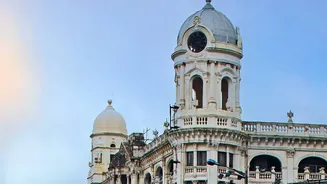
A short walk away stands the magnificent General Post Office (GPO), instantly recognizable by its towering white dome and grand Corinthian pillars. Designed by Walter Granville and completed in 1868, this building stands on the site of the original Fort William, which was destroyed during the Siege of Calcutta in 1756. A brass plate on the eastern side still marks the boundary of the old fort. The GPO is not just an architectural marvel combining Neoclassical and Victorian elements; it’s a functional piece of history, still serving as the city's primary post office.
St. John's Church: A Sanctuary of History
Tucked away in a quiet corner near Raj Bhavan is St. John's Church, one of Kolkata’s oldest and most significant churches. Consecrated in 1787, it was the main Anglican cathedral until St. Paul's Cathedral was built. Often called 'Pathure Girja' or the Stone Church, it was constructed using stones brought from the medieval ruins of Gour. The churchyard is a history lesson in itself, containing the mausoleum of Job Charnock, traditionally considered the founder of Calcutta, and memorials to other key figures of the colonial era. Inside, a notable painting of 'The Last Supper' by Johann Zoffany adds to its artistic treasures.
Expanding the Walk: The Grand Esplanade
From B.B.D. Bagh, your walk can extend towards the grand boulevards of the Esplanade area. Here you will find Raj Bhavan, the palatial residence of the Governor, which was built to mirror Kedleston Hall in England. Lord Wellesley, the governor-general who commissioned it, famously believed India should be 'governed from a palace, not a counting house'. Nearby, the Calcutta High Court, a stunning neo-Gothic structure inspired by a Belgian town hall, stands as the oldest High Court in India. These buildings, along with others like the Town Hall and Metcalfe Hall, complete the picture of a city built to project imperial power and prestige.
Tips for Your Heritage Stroll
To make the most of your walk, start early in the morning to avoid the city’s heat and crowds, as many guided tours do. Wear comfortable walking shoes, as you’ll be covering a fair bit of ground. While the exteriors of these buildings are freely accessible, entry into some, like the Raj Bhavan, is restricted, and others may have specific visiting hours. Many private companies offer guided walking tours that provide deep historical context and anecdotes you might otherwise miss. Keep a camera handy, but more importantly, allow yourself to soak in the atmosphere of a city where history stands proudly amidst the modern hustle.