

A New Eye on the Cosmos
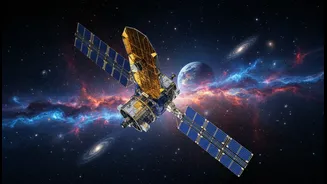
Set to launch by late 2026, the Nancy Grace Roman Space Telescope is NASA's next great space observatory, a mission on the same scale as the Hubble and James Webb space telescopes. Named after Nancy Grace Roman, NASA’s first chief of astronomy and the “Mother
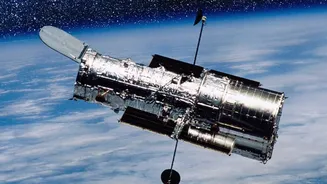
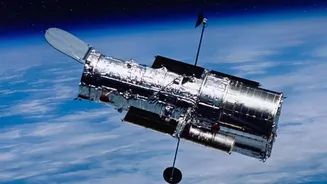
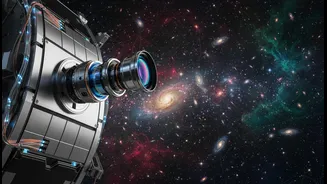
of Hubble,” this telescope is designed with a specific purpose: to tackle some of the biggest puzzles in cosmology. Its primary goals are to investigate the mysterious forces known as dark energy and dark matter, and to dramatically expand the census of planets beyond our solar system, or exoplanets. With a 2.4-meter primary mirror, the same size as Hubble's, Roman is built upon a legacy of cosmic discovery, but with powerful new capabilities that promise to reshape our view of the universe.
The Power of a Bigger Picture
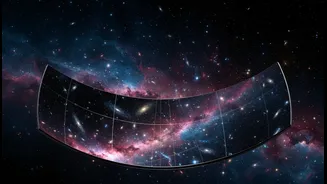
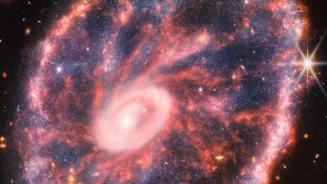
Roman's transformative potential lies in its incredible field of view. Its Wide Field Instrument can capture an area of the sky at least 100 times larger than Hubble's infrared camera in a single snapshot, all while maintaining a similar, crystal-clear resolution. This panoramic capability is a game-changer. Where Hubble would need to painstakingly stitch together hundreds of images to map a small patch of sky, Roman can capture it in just one or two pointings. This efficiency will allow it to conduct vast surveys, mapping billions of galaxies and stars over its five-year primary mission. It’s the difference between studying a single tree and being able to map the entire forest, providing the large-scale cosmic context that has been missing.
Hunting Cosmic Phantoms
About 95% of the universe is made up of dark energy and dark matter, yet we know almost nothing about them. Dark matter provides the gravitational scaffolding that holds galaxies together, while dark energy is the enigmatic force causing the universe's expansion to accelerate. Roman will tackle these mysteries by creating a colossal 3D map of the universe. It will measure the precise locations and distances of billions of galaxies and track the light from distant stellar explosions called supernovae. By studying how the distribution of galaxies has changed over cosmic time and how the expansion has sped up, scientists can test theories about the nature of dark energy. Roman will also map how the light from distant galaxies is bent by the gravity of unseen dark matter, revealing its distribution in unprecedented detail.
Discovering a Universe of New Worlds
Beyond cosmology, Roman is set to be an unparalleled planet-hunting machine. While missions like Kepler have found thousands of exoplanets, they primarily use the 'transit' method, which is best for finding large planets orbiting very close to their stars. Roman will pioneer the use of a technique called gravitational microlensing on a massive scale. This method can detect planets much farther from their star, in orbits similar to Earth's or even Jupiter's, and can even find planets as small as Mars. A microlensing event occurs when a star with a planet passes in front of a more distant star, and its gravity acts like a magnifying glass, briefly brightening the background starlight. Scientists anticipate Roman will discover thousands of new worlds this way, including analogs to nearly every planet in our solar system and even free-floating 'rogue' planets that wander the galaxy alone.