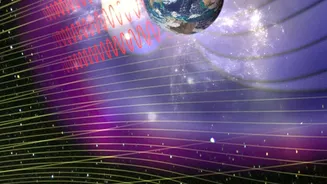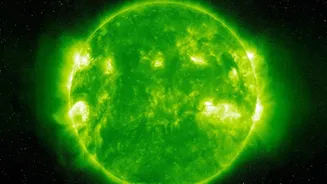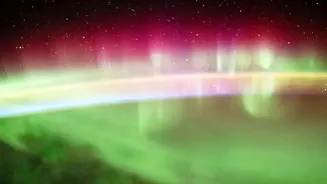

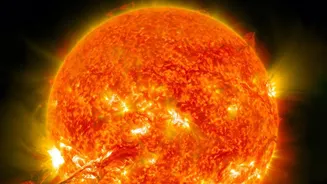
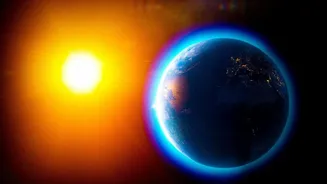
The Sun, our life-giving star 93 million miles away, has a volatile side. Massive eruptions can hurl energy and particles toward Earth, posing a silent but significant threat to the vast, interconnected electrical networks we rely on every day.
What Is a Solar Storm?
A solar
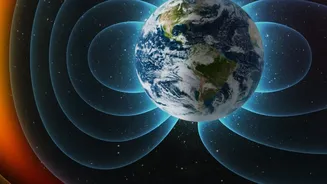
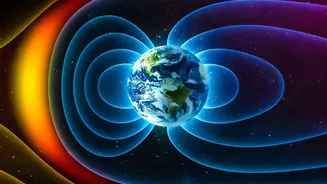
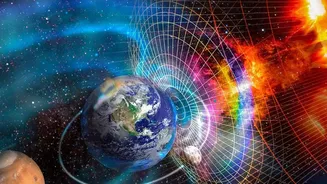
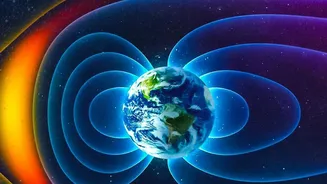
storm is a disturbance on the Sun that can blast energy and charged particles into space. These events primarily take two forms: solar flares and coronal mass ejections (CMEs). A solar flare is an intense burst of radiation from the release of magnetic energy on the Sun's surface. A CME, which often follows a flare, is a massive eruption of plasma and magnetic fields from the Sun's outer atmosphere, the corona. When a CME is aimed at Earth, it can travel across the solar system and collide with our planet's protective magnetic field, known as the magnetosphere.
How Space Weather Reaches the Grid
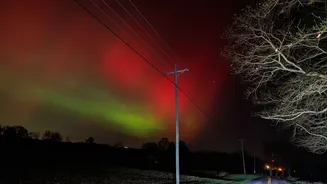
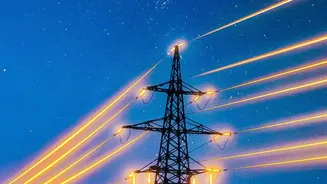
When a powerful CME interacts with Earth's magnetosphere, it causes rapid and intense fluctuations in the planet's magnetic field. According to Faraday's law of induction, these time-varying magnetic fields induce powerful electric fields at the Earth's surface. These electric fields, in turn, can drive quasi-DC currents through any long, conductive networks, like pipelines, railway lines, and, most critically, high-voltage power transmission lines. These unwanted currents are known as geomagnetically induced currents, or GICs. The intensity of these currents can be influenced by regional geology; areas with highly resistive bedrock can make it harder for the currents to dissipate into the ground, amplifying their effect on the grid.
The Threat to Transformers
The heart of the problem lies with large power transformers, the backbone of any transmission grid. These devices are designed to operate on alternating current (AC), but GICs introduce a quasi-direct current (DC) component. This DC bias can push the transformer's magnetic core into saturation during part of the AC cycle. A saturated core draws far more reactive power from the system to maintain its magnetic field, which can lead to system-wide voltage instability or even collapse. Furthermore, this saturation causes stray magnetic flux to escape the core, inducing eddy currents in the transformer's structural components and windings. This process generates intense heat, creating hotspots that can physically damage the transformer, melting windings or degrading its insulating oil. Such damage is often irreparable, requiring a full replacement of a unit that is expensive and can take months to build and install.
Recent Studies Highlight Vulnerabilities
While the headline's specific 'study' is general, a wave of recent research has sharpened our understanding of these risks. A 2026 study published in AGU Advances modeled the potential economic fallout of a severe storm on the U.S. grid, estimating daily losses could reach $1.81 billion in an extreme scenario, with millions of people losing power. The research identified the Northeast and Northern Plains as particularly vulnerable due to their geology and grid structure. Another recent NASA-led study published in 'Nature' challenged a longheld belief that Earth's magnetosphere has a builtin 'ceiling' for how much energy it can absorb. The new analysis suggests there may be no such limit, meaning the effects of an extreme solar storm could be up to twice as severe as previously thought, posing a greater threat to satellites, communications, and power grids.
Learning from History and Preparing for the Future
History provides stark warnings. The Carrington Event of 1859, the most powerful geomagnetic storm on record, occurred before the modern grid existed but still caused telegraph systems to spark and fail. More recently, a March 1989 storm collapsed the HydroQuébec power grid in Canada in just 92 seconds, leaving millions in the dark for nine hours. In response to these threats, grid operators and researchers are developing mitigation strategies. These include 'hardening' the grid by installing GICblocking devices or capacitor banks that can absorb the rogue currents. Improved space weather forecasting from agencies like NOAA's Space Weather Prediction Center provides crucial advanced warning, allowing operators to take preemptive measures like reducing load on vulnerable transformers or temporarily taking them offline to prevent catastrophic damage.