


The Solar System's Slowest Spin
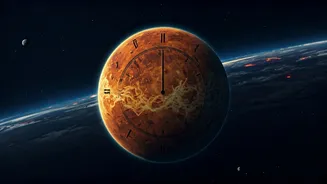
To get your head around this, we first need to separate two concepts: a year and a day. A year is the time it takes a planet to complete one full orbit around the sun. A day is the time it takes to complete one full rotation on its own axis. For Venus,
that orbit takes about 225 Earth days, making its year shorter than ours. But its rotation is shockingly slow. It takes Venus a whopping 243 Earth days to spin around just once. So, if you measure a 'day' by a single full rotation, it is indeed longer than its year (243 vs. 225). This makes Venus the slowest-rotating planet in the entire solar system. While Earth is zipping around on its axis once every 24 hours, Venus is taking a leisurely, almost static, approach to its daily spin.
But a Day Isn't That Simple
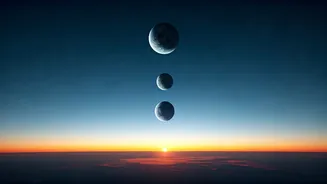
Here's where it gets even weirder. The 'day' we just described (243 Earth days) is what astronomers call a sidereal day—a rotation relative to the distant stars. But what about a day as we experience it, from one sunrise to the next? That's a 'solar day,' and on Venus, it’s completely different. Venus spins backward, a phenomenon known as retrograde rotation. While every other planet (except Uranus, which is on its side) spins counter-clockwise, Venus spins clockwise. This means the sun on Venus rises in the west and sets in the east. Because the planet is rotating backward as it orbits the sun, the time between sunrises is much shorter than its rotational period. A solar day on Venus ends up being about 117 Earth days long. So you’d only experience about two sunrises for every Venusian year. It's an environment where the 'day' is still months long, and the sun crawls across the sky at an agonizingly slow pace.
A Portrait of a Hellish World
This bizarre timing is a fitting backdrop for what is arguably the most inhospitable planet in our solar system. Venus is often called Earth’s 'twin' because of its similar size and mass, but it’s more like an evil twin. The surface temperature is a steady 900°F (475°C), hot enough to melt lead. This isn't due to its proximity to the sun alone; it’s the result of a runaway greenhouse effect. Its atmosphere is almost entirely carbon dioxide—thick, toxic, and suffocating. The atmospheric pressure at the surface is more than 90 times that of Earth's, equivalent to what you’d feel nearly 3,000 feet deep in our ocean. Any spacecraft that has ever landed there has been crushed and cooked within hours. To top it off, the planet is shrouded in thick clouds of sulfuric acid. A long, backward day is just one of many features that make Venus a true vision of hell.
Why the Bizarre Rotation?
So why is Venus so strange? Scientists don’t have a definitive answer for its slow, retrograde rotation, but there are a few leading theories. One popular hypothesis suggests that early in its history, Venus was struck by a massive planet-sized object (or a series of smaller ones) that effectively flipped it upside down and dramatically slowed its spin. Another compelling theory points to its incredibly thick atmosphere. Over billions of years, the gravitational pull of the sun on this dense, churning atmosphere could have created powerful atmospheric tides. These tides may have acted like a brake, gradually slowing the planet’s rotation to its current crawl and even reversing its direction. Whatever the cause, the result is a world fundamentally different from our own, governed by a completely alien sense of time.