



Reading the Winds of Another World
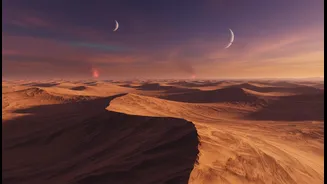
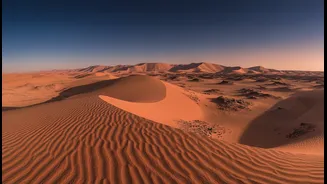
On Earth, we have weather stations to measure wind. On Mars, scientists use the dunes. These vast fields of sand, often made of dark, volcanic basalt, are shaped entirely by the planet's thin but persistent winds. By studying high-resolution images from
orbiters like NASA's Mars Reconnaissance Orbiter (MRO), researchers can read the history and current state of Martian winds. Specific dune shapes, like the crescent-shaped barchans, act as natural weather vanes. Their orientation and shape provide a snapshot of the prevailing wind direction over thousands of years, allowing scientists to create global wind maps without ever placing an instrument on the ground.
A Seasonal Story Told in Frost and Dust
The dunes don't just record wind; they also tell a dramatic seasonal story. During the harsh Martian winter, a significant portion of the planet's carbon dioxide atmosphere freezes, blanketing the dunes in a layer of dry ice. As spring arrives and the sun warms the surface, this ice doesn't melt—it sublimates, turning directly into gas. This process can be explosive. Gas trapped beneath the ice sheet can erupt, launching dark sand and dust into the air. These eruptions create dark fan-shaped deposits and strange, spider-like channels on the ice, providing a real-time indicator of seasonal atmospheric changes and revealing how actively the landscape is being reshaped.
A Tale of Two Ripples
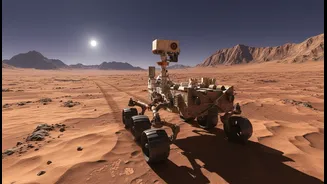
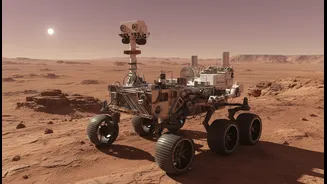
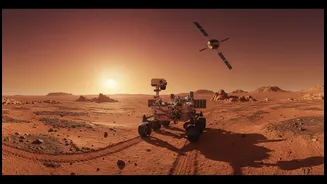
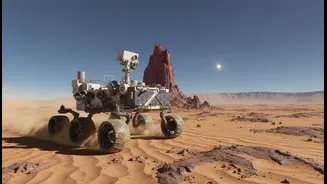
The story gets even more detailed when looking closely at the sand itself. Images from rovers like Curiosity revealed two distinct sizes of ripples on Mars: small ones similar to those on Earth, and larger, meter-scale waves not typically seen in our planet's deserts. For years, these larger ripples were a puzzle. Recent studies suggest they are a unique type of miniature dune whose growth is limited by Mars' incredibly thin atmosphere. The very existence of these different patterns is directly tied to the planet's atmospheric pressure. This means that by studying ancient, fossilized dunes preserved in Martian rock, scientists can potentially reconstruct the history of Mars' atmosphere, helping them understand when and why it lost its once-thicker air.
Clues for Climate and Future Missions
Understanding this planetary-scale weather system is crucial for several reasons. For one, it helps scientists refine their models of planetary climates, including our own. Mars provides a simpler system, without the complexities of oceans and a biosphere, making it an ideal testing ground for theories about atmospheric physics. On a practical level, mapping how and where sand moves is vital for future exploration. Mars experiences planet-encircling dust storms, and its dunes can migrate, albeit slowly. Knowing where the surface is active helps mission planners select safe landing sites and routes for rovers, ensuring they don't get buried by shifting sands. These studies turn beautiful landscapes into critical safety maps.