




The Galaxy's Most Common Planets
Our solar system gives us a neat lineup of planets: small rocky worlds near the Sun, and giant gas and ice planets farther out. For a long time, these were our only models. But as we’ve discovered thousands of exoplanets, a new category has emerged as one
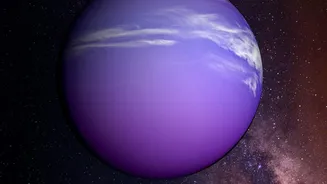
of the most common: Neptune-sized worlds. Many of these, known as 'Warm Neptunes,' orbit their stars much closer than our own Neptune or Uranus. They are not as scorching as 'hot Jupiters,' but they are bathed in far more stellar radiation than anything in our outer solar system. This unique position makes them perfect laboratories for studying how planetary atmospheres are shaped and transformed over billions of years. They challenge simple ideas of planet formation, existing in a mysterious 'desert' where planets of their size are rarer than expected, suggesting many may have been transformed or destroyed over time.
Methane: A Planetary Thermometer
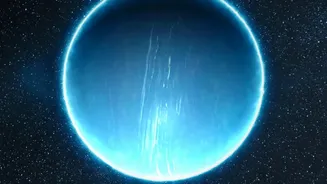
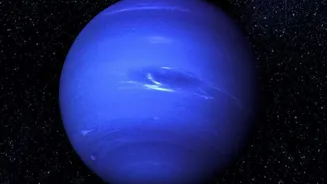
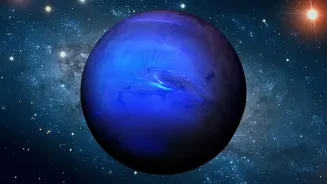
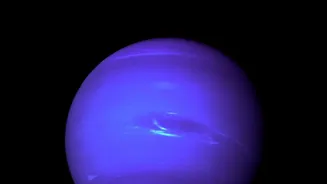
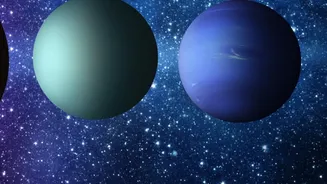
In the cold, distant reaches of our own solar system, the atmospheres of Neptune and Uranus are rich in methane. It's what gives them their distinct blue hues. Basic chemistry predicts that on a gas-rich planet of a certain temperature, carbon should primarily exist as methane. For years, astronomers expected to find it abundantly on Warm Neptunes. But early observations with the Hubble Space Telescope and others often came up empty, showing far less methane than models predicted. This persistent 'methane depletion' became a major puzzle. Was the carbon missing, or was something actively destroying the methane? Answering this would require a new level of observational power, which arrived with the James Webb Space Telescope (JWST).
JWST's Surprising Methane Signal
The James Webb Space Telescope's powerful infrared instruments have finally started detecting definitive methane signatures in the atmospheres of these worlds. On planets like WASP-80 b and WASP-107 b, JWST has found methane, but in perplexing amounts. For instance, on WASP-107 b, methane was found to be depleted by a factor of 1,000 compared to what chemical equilibrium would suggest. The presence of methane confirms it can exist in these environments, but its low quantity points to a powerful disequilibrium process at work. The planet's atmosphere isn't just a static soup of chemicals; it's an active, churning system where gases are being destroyed and mixed with incredible vigor.
The Battle of Chemistry and Circulation
The methane readings from JWST tell a story of two competing forces. The first is photochemistry. Intense radiation from the host star breaks down methane molecules in the upper atmosphere. The second is vertical mixing. Vigorous winds, driven by the planet's internal heat and the external radiation, dredge up hotter gas from deep within the planet's interior. In these hotter layers, carbon prefers to be in the form of carbon monoxide, not methane. So, this rapid mixing constantly pollutes the upper atmosphere with methane-poor gas. On WASP-107 b, scientists concluded that this vigorous vertical mixing, not photochemistry, is the primary reason for the low methane levels. The atmosphere is churning so violently that methane can't reach its expected concentration before being destroyed or diluted.
Rewriting Planetary Histories
These findings do more than just solve a chemical puzzle; they give us a window into a planet's past and its very core. By modeling the vigorous mixing needed to explain the methane levels on WASP-107 b, scientists inferred that the planet must have a much hotter interior and a more substantial core than previously thought. This resolved a tension with planet-formation theories, which had struggled to explain how such a low-density planet could have formed. The story of atmospheric evolution is that some planets are being stripped bare by their stars, their hydrogen and helium envelopes bleeding into space. This process, called atmospheric escape, could explain the 'hot Neptune desert' by suggesting these worlds eventually shrink into smaller, rocky 'super-Earths.' By studying the atmospheric chemistry, we are learning which planets are stable and which are in the process of a dramatic transformation.