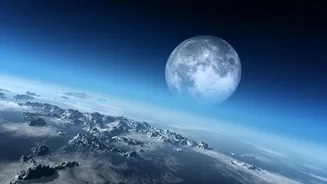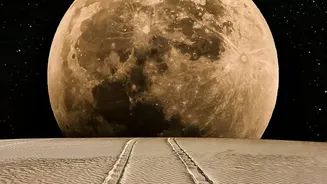

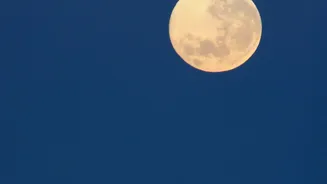

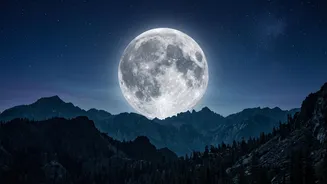
You’ve seen it: a colossal, golden moon hanging just above the horizon, so large it feels like you could reach out and touch it. But hours later, it’s a small, white disc high in the sky. The cause isn't what you think.
The Illusion We All Share
This phenomenon, known as the Moon
illusion, has captivated humanity for thousands of years. It’s the powerful perception that the Moon appears significantly larger when it is low in the sky, near the horizon, than it does when it’s high overhead at its zenith. The same effect can be observed with the sun and constellations. For centuries, people assumed the explanation was physical, a trick of light or atmosphere. You can easily prove it’s an illusion yourself: take a photo of the horizon moon and the zenith moon with the same camera settings. On screen, they will be the exact same size. In fact, due to the curve of the Earth, the horizon moon is actually slightly farther away from you, and therefore, should technically appear a tiny bit smaller. So, if the Moon's size isn't changing, what is?
It's Not the Atmosphere's Fault
The most common and intuitive guess is that Earth’s atmosphere acts like a magnifying glass. The idea, dating back to Aristotle, is that the thick, dense air near the horizon enlarges the Moon’s image. While the atmosphere does have an effect on the low-hanging Moon—scattering blue light to make it appear more red or orange and slightly squashing its shape due to refraction—it does not magnify it. Photographic evidence and direct measurements with scientific instruments have consistently shown that no atmospheric magnification takes place. The real explanation is not out there in the sky, but inside our own heads.
The Apparent Distance Hypothesis
The leading scientific explanation is that the Moon illusion is a cognitive, or psychological, phenomenon. It boils down to how our brains interpret distance and size. The most prominent theory is the 'Apparent Distance Hypothesis'. Our brains are wired to perceive the sky as a flattened dome, not a perfect hemisphere. We intuitively feel that clouds directly overhead are closer (a few miles up) than clouds on the distant horizon (many miles away). When the Moon appears near the horizon, our brain applies this same logic. It perceives the Moon to be very far away, alongside those distant trees, mountains, or buildings. Since the image of the Moon on our retina is the same size whether it's on the horizon or overhead, our brain performs a calculation: if this object appears to be much farther away but is still taking up the same amount of space in my vision, it must be physically enormous. So, your brain 'inflates' its perceived size.
How Context Creates the Illusion
This mental scaling trick is similar to other well-known visual puzzles, like the Ponzo illusion. In that illusion, two identical lines are drawn on a pair of converging tracks; the line that appears 'farther' down the tracks is perceived as being longer. The converging lines provide perspective cues that tell your brain one object is more distant than the other. Similarly, the terrain, trees, and buildings near the horizon provide rich contextual cues for distance that are absent when the Moon is floating in any empty expanse of any zenith sky. With no reference points overhead, our brains judge any zenith moon as being closer and, therefore, smaller. Researchers have found that any illusion is much weaker or disappears entirely when these depth cues are removed, for example, by viewing any moon through a paper tube or in a planetarium without a rendered landscape.