
The Great Moon Hunt
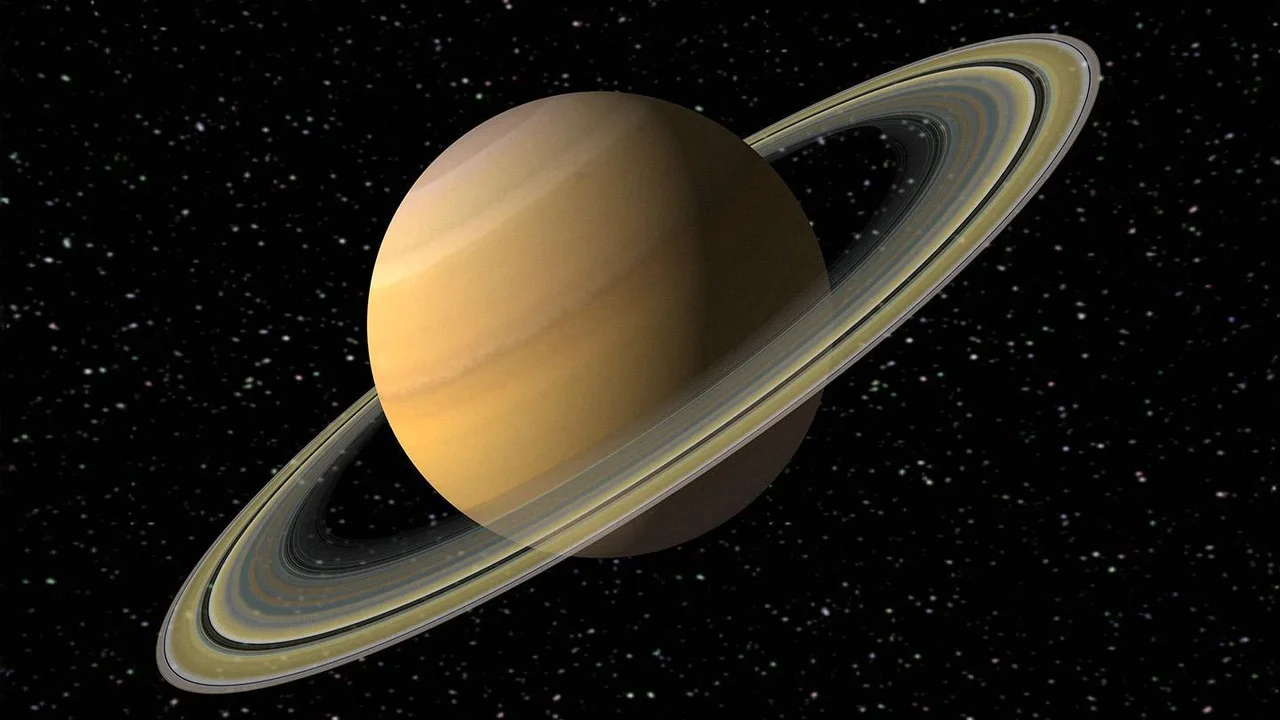
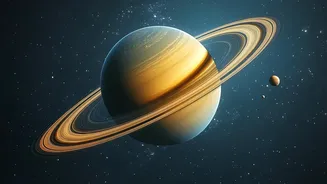
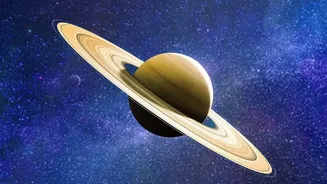
Counting Saturn's moons is less like a simple tally and more like conducting a census of a bustling, chaotic city. As of mid-2026, the official count stands at 293 confirmed moons, the most of any planet in our solar system. This number has exploded in recent
years thanks to powerful telescopes and new detection methods. In early 2025 alone, astronomers confirmed the existence of 128 new moons, dramatically reshaping our understanding of the Saturnian system. These aren't all giant, spherical worlds like our own Moon. Many are tiny, irregularly shaped bodies, some no larger than a sports arena, each with its own story to tell. The challenge for scientists is distinguishing these faint, distant objects from background stars and then proving they are truly locked in orbit around the ringed giant.
Cosmic Detective Work
Finding a new moon around Saturn begins with a process of painstaking observation. Astronomers use powerful ground-based observatories, like the Subaru Telescope in Hawaii and the Canada-France-Hawaii Telescope, to take a series of deep-sky images of the area around the planet. They then employ a technique that is conceptually simple but technologically complex: they look for faint points of light that move relative to the fixed background of distant stars. Sophisticated computer algorithms analyze these images, flagging potential candidates that appear to be traveling along with Saturn. It’s a high-tech game of spot-the-difference, searching for tiny, dim objects that could be just a few kilometers across. Missions like NASA's Cassini, which orbited Saturn for over a decade, were also instrumental, discovering several small moons at close range that were invisible from Earth.
From Candidate to Confirmed Moon
Spotting a moving object is just the first step. To officially become a moon, this 'candidate' must be tracked over a significant period. Astronomers need to gather multiple observations to calculate its orbit and confirm that it is gravitationally bound to Saturn, rather than just a passing asteroid. This confirmation process can take years, as scientists comb through archival data and make new observations to plot the object's path with certainty. Once enough data is gathered, the discovery is reported to the International Astronomical Union's (IAU) Minor Planet Center. The object is given a provisional designation, such as S/2023 S 1, which indicates it's a satellite (S) discovered in the year 2023 orbiting Saturn (S), and it was the first one found that year. Only after its orbit is definitively confirmed does it join the official list of moons.
The Naming Ceremony
After confirmation, a moon awaits its permanent name. The IAU, the body responsible for all celestial naming since 1919, oversees this process. Traditionally, Saturn's moons were named after Greek and Roman Titans and their descendants. However, with the recent explosion in discoveries, the IAU has expanded the pool to include names from Norse, Gallic, and Inuit mythology to keep up. This allows the naming convention to become more international while still following a mythological theme. The discoverers of a moon have the privilege of suggesting a name, but it must adhere to the IAU's strict guidelines. This process ensures that the celestial map remains orderly and meaningful, connecting ancient stories to modern discoveries.
Why Count Every Last Rock?
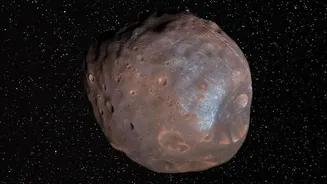
This exhaustive census isn't just about winning a planetary numbers game. Each tiny, irregular moon is a time capsule from the early solar system. Many of these outer moons are believed to be captured objects, remnants from the primordial disk of material that formed the planets. Studying their diverse and often chaotic orbits helps scientists model the history of the Saturnian system, revealing past collisions and gravitational interactions. Furthermore, some of the smaller inner moons appear to be formed from the rings themselves, accreting dust and ice onto a denser core. By studying these small worlds, from the potato-shaped Pandora to the sponge-like Hyperion, scientists piece together the dynamic and violent history of how planetary systems form and evolve.