





The Sun's Power to Silence the Skies
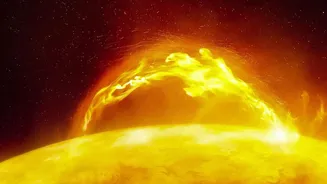
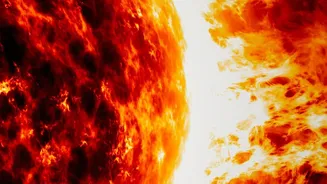
The sun is in a constant state of activity, but sometimes this energy is released in massive, violent bursts. The two main types of solar explosions are solar flares and coronal mass ejections (CMEs). A solar flare is an intense flash of radiation that
travels at the speed of light, reaching Earth in just eight minutes. This radiation supercharges the Earth's ionosphere, the atmospheric layer that high-frequency (HF) radio signals bounce off of to travel long distances. During a strong flare, this enhanced ionosphere absorbs HF radio waves instead of reflecting them, causing a radio blackout on the sunlit side of the Earth. For pilots flying over oceans or polar regions, where satellite links can be sparse, HF radio is a vital line of communication. A sudden blackout can leave a flight crew without a key connection to air traffic control.
Flares vs. CMEs: A Crucial Distinction
While related, flares and CMEs are different phenomena with different impacts. If a solar flare is the bright muzzle flash from a cannon, a CME is the cannonball itself—a massive cloud of magnetized plasma hurled into space. These ejections travel much slower, taking one to three days to reach Earth. While flares cause immediate radio blackouts, CMEs that hit Earth can trigger geomagnetic storms, which create a host of other problems, including broader disruptions to GPS, satellite operations, and even power grids on the ground. Often, the most powerful flares are accompanied by CMEs. The key challenge—and opportunity—is seeing these events as they happen so that industries like aviation can prepare.
A Man-Made Eclipse in Space
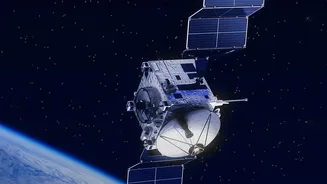
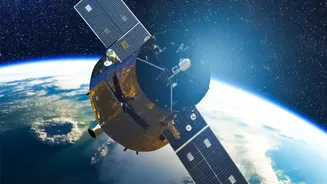
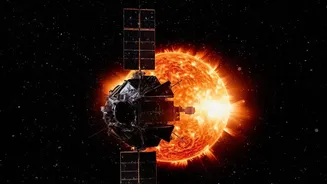
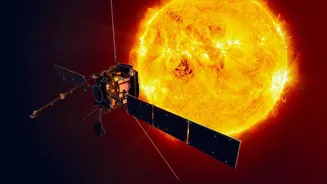
This is where coronagraphs come in. A coronagraph is a special telescope designed to observe the sun's incredibly faint outer atmosphere, called the corona. It works by creating an artificial eclipse, using a disc to block the overwhelming glare from the sun's main surface. Without the sun's direct light washing everything out, scientists can see the structure of the corona and, most importantly, spot a CME as it erupts and travels outward. Satellite-based coronagraphs, like the LASCO instrument on the SOHO spacecraft and the newer CCOR instruments on GOES satellites, provide a constant watch. They are our eyes on the sun, giving us a crucial heads-up about potentially disruptive CMEs heading our way.
From Satellite Data to Cockpit Advisory
The journey from a satellite image to a pilot's alert is a model of global cooperation. When a coronagraph detects an Earth-directed CME, the data is sent to space weather forecasting centers like the NOAA Space Weather Prediction Center (SWPC) in the United States. Analysts at SWPC use this data, along with other solar observations, to model the CME's trajectory, speed, and potential impact. Based on these models, they issue watches, warnings, and alerts. For the aviation sector, these advisories are distributed through bodies like the International Civil Aviation Organization (ICAO). Airlines and flight dispatchers receive alerts about expected radio blackouts, GPS degradation, or increased radiation levels, allowing them to make informed decisions before and during a flight.
The Impact of an Early Warning
This forecasting system is more than just an academic exercise; it has a direct impact on flight safety and efficiency. An early warning of a solar radiation event can allow an airline to reroute a flight that was planned to fly over a polar region, avoiding the area where HF communication would be most affected and radiation exposure is highest. Dispatchers might advise pilots to rely on alternative communication systems or prepare for potential navigation inaccuracies. By anticipating the disruption, airlines can prevent flight delays, avoid communication blackouts, and ensure the safety of passengers and crew without unnecessarily grounding flights. This proactive approach saves time and money, but most importantly, it adds an invisible layer of safety to modern air travel.