







The Old-School Method: Pen and Paper
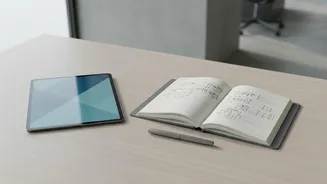
For generations, the most reliable meeting tool was a notebook. The act of writing things down by hand isn't just tradition; it has cognitive benefits. Research shows that writing by hand engages more areas of the brain, which can improve memory and comprehension
of the topics discussed. When you manually jot down notes, you're forced to listen actively, synthesise information, and prioritise what's important. This process of 'encoding' helps the information stick. However, the downsides are significant in a fast-paced work environment. Handwritten notes are personal, often messy, and time-consuming to transcribe and share. The crucial action items and decisions captured in your notebook are siloed until you manually type them up and send them out, creating a delay that can slow down entire projects.
The New Contender: AI Meeting Assistants
Enter the AI meeting assistant. Tools like Otter.ai, Fathom, and Microsoft Copilot join your virtual meetings to automatically record, transcribe, and summarise the entire conversation. Their primary promise is to liberate participants from the burden of note-taking, allowing everyone to focus on the discussion itself. Within minutes of the meeting ending, these platforms can deliver a full searchable transcript, a concise summary of key points, and, most importantly for follow-up, a list of automatically identified action items. This immediate availability of structured information aims to eliminate the lag and manual effort associated with traditional methods, ensuring that post-meeting tasks can begin without delay.
Round 1: Speed and Efficiency
When it comes to speed, AI is the undisputed winner. An AI-generated summary and list of action items can land in your inbox moments after a meeting concludes. This speed dramatically increases the likelihood that tasks will be remembered and acted upon while the conversation is still fresh in everyone's mind. Manually processing handwritten notes, on the other hand, involves finding the time to decipher your scribbles, type them into a clear format, and distribute them to the team. This process can take hours, if not days, by which point momentum has often been lost. For teams struggling with post-meeting delays, the efficiency gains from AI are substantial, potentially saving several hours per week.
Round 2: Accuracy and Action Items
Here, the comparison becomes more nuanced. AI provides a verbatim transcript, capturing every single word spoken. This offers comprehensive accuracy that a manual note-taker can never match. For conversations where precise details are critical, this is a major advantage. AI tools are also increasingly adept at identifying and assigning action items. However, AI can lack the contextual understanding to interpret nuance, sarcasm, or implied meaning. It might mistake a passing comment for a firm commitment or miss a subtle but critical decision. A human note-taker, while less comprehensive, excels at interpretation. They can filter out noise, understand context, and capture the intent behind the words, which is often more important for follow-up than the words themselves.
Round 3: The Human Element
Beyond pure mechanics, there's the human factor. Actively taking notes by hand keeps you engaged and focused during the meeting. It forces a deeper level of processing that can lead to better insights. Relying entirely on an AI bot can sometimes lead to passive participation. Furthermore, the presence of a recording bot can change the dynamic of a conversation, making participants more guarded, especially in sensitive discussions like performance reviews or confidential negotiations. There are also valid privacy and data security concerns to consider when using third-party AI tools. The trust and rapport built in a meeting can be just as important as the action items that come out of it, and this is an area where the human touch remains irreplaceable.