



A New Eye on the Cosmos
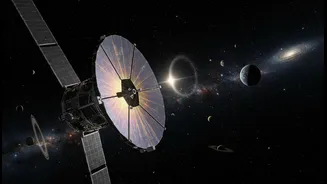
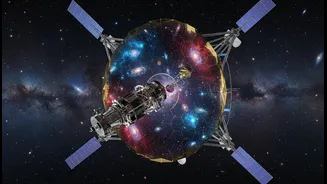
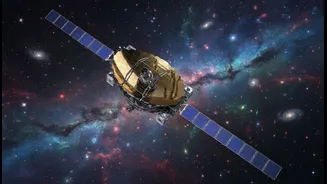
The mission at the heart of this new era of discovery is NASA's Nancy Grace Roman Space Telescope. Scheduled for launch by August 2026, Roman is considered the next great space observatory, a successor to the legacies of Hubble and the James Webb Space Telescope. Named
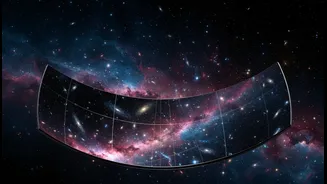
after NASA's first chief of astronomy, the telescope has a primary mirror the same size as Hubble's but features a field of view 100 times larger. This vast perspective will allow it to map huge sections of the sky with incredible speed and detail, creating cosmic panoramas that will help answer deep questions about our universe, including the mysteries of dark energy and dark matter. But one of its most exciting tasks is to conduct a massive hunt for exoplanets—worlds outside our solar system. Scientists anticipate it could find around 100,000 new planets, a colossal leap from the roughly 6,000 confirmed so far.
Einstein’s Cosmic Magnifying Glass
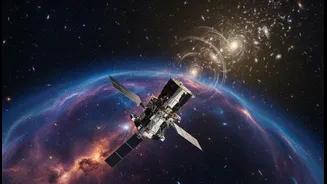
Roman will primarily find these worlds using a technique called gravitational microlensing. The method is a direct consequence of Albert Einstein's theory of General Relativity, which states that massive objects warp the fabric of spacetime. Imagine a heavy bowling ball on a trampoline; it creates a dip that a rolling marble will curve around. Similarly, the gravity of a star can act as a lens, bending and magnifying the light from a more distant star that passes directly behind it from our point of view. This chance alignment causes the background star to temporarily brighten in a predictable way. If the foreground star—the lens—has a planet orbiting it, the planet’s own smaller gravity adds a second, brief spike of brightness to the event. This tiny, extra blip in the light curve is the telltale signature of a planet. These events are rare and fleeting, lasting only a few hours for a planet, which is why Roman’s ability to constantly monitor hundreds of millions of stars is a game-changer.
Hunting for Hidden and Rogue Worlds
Other planet-hunting methods, like the transit method used by the Kepler space telescope, are best at finding large planets orbiting very close to their stars. They detect the tiny dip in a star's light as a planet passes in front of it. Microlensing is different. It is uniquely sensitive to planets that are further from their star, in orbits similar to Jupiter or even Earth, and can detect worlds with masses smaller than our own planet. Most remarkably, microlensing is the only method capable of finding "rogue planets." These are free-floating worlds that have been ejected from their home systems and wander through the galaxy untethered to any star. By detecting the light-bending effects of these dark, isolated objects, Roman is expected to find hundreds of them, offering the first real census of this mysterious planetary population. Scientists estimate there could be trillions of these lone worlds in the Milky Way, potentially outnumbering stars themselves.
A Galactic Census Like Never Before
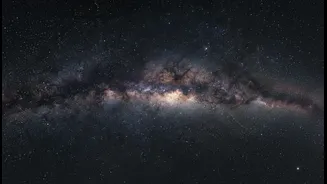
By using gravitational microlensing, Roman will probe deep into the heart of our Milky Way galaxy, an area dense with stars but difficult to study with other methods. This will give us a more complete picture of planetary systems across different galactic environments. For example, are planets more common near the galaxy's center, where the building blocks of planets are more abundant? Or does the harsh radiation in that crowded region hinder their formation? Roman's survey will provide the data to start answering these questions. Furthermore, because microlensing can detect planets at immense distances—thousands of light-years away—it will create a galactic map of planets on an unprecedented scale. This census will revolutionize our understanding of planet formation and help determine just how common worlds like our own might be across the cosmos. It will fill in crucial gaps in our knowledge, revealing the planets that other telescopes simply cannot see.