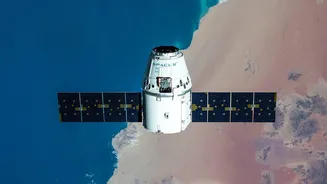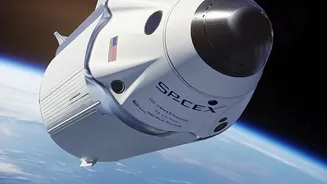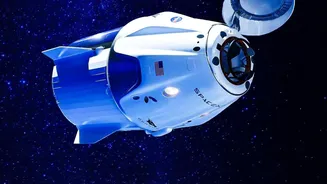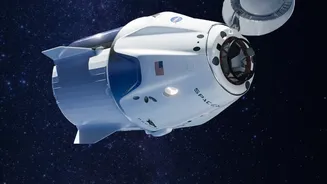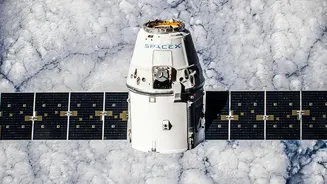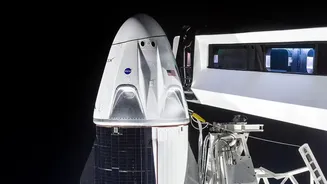




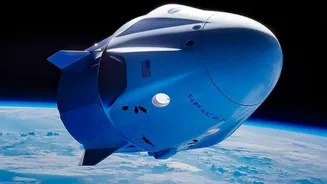
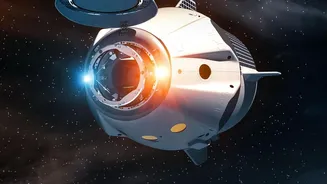
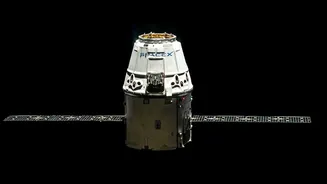
SpaceX's Dragon spacecraft has successfully returned to Earth, splashing down in the Pacific Ocean to conclude its 35th Commercial Resupply Services (CRS) mission for NASA. This return journey was more than just a homecoming; it was a delivery of priceless
scientific data.
Mission Accomplished
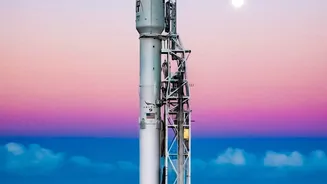
The uncrewed Dragon capsule completed its journey on Saturday, November 21, splashing down off the coast of California. The capsule undocked from the International Space Station (ISS) on Friday, November 20, beginning its approximately 29-hour trip back through the atmosphere. This successful splashdown marks the end of a mission that began on October 13 with a launch aboard a Falcon 9 rocket from Cape Canaveral, Florida. After arriving at the station on October 15, the Dragon delivered over 2,860 kilograms of supplies, hardware, and scientific gear to the orbiting laboratory.
A Precious Cargo of Science
While the delivery of supplies is crucial for the station's crew and operations, the Dragon's most critical function is its ability to return scientific experiments to Earth intact. Unlike other cargo vehicles that burn up on reentry, the Dragon is designed for a safe return, making it indispensable for time-sensitive research. This mission's return cargo is particularly significant, carrying a host of biological samples that could lead to breakthroughs in human health. Among the key experiments are frozen tumor organoids that were treated in space to test chemotherapy responses, potentially paving the way for more personalized cancer treatments.
Groundbreaking Health Research
Also aboard the returning capsule was a 3D-bioprinted blood vessel construct. By studying how these tissues, created with living cells, develop in microgravity, scientists hope to gain a deeper understanding of cardiovascular disease and the aging process. Another vital investigation involves frozen microbial samples. Researchers will analyze these to see how antibiotic-resistant bacteria survive and evolve in the unique environment of space, a field of study with major implications for astronaut health on long-duration missions and for combating antibiotic resistance on Earth. Additionally, a specialized lighting system, tested on the station for over three years to improve astronaut sleep and well-being, was returned for evaluation.
The Commercial Space Workhorse
The CRS-35 mission highlights the maturity and reliability of NASA's partnership with commercial companies like SpaceX. This was the fourth flight for this specific Dragon capsule, demonstrating the cost-effectiveness and efficiency of reusable spacecraft. The mission also delivered the final pair of new International Space Station Roll-Out Solar Arrays (iROSAs) to the station, which have increased its power generation capacity by up to 30 percent, enabling more science and technology demonstrations. These routine-seeming cargo runs are the backbone of the research being conducted on the ISS, ensuring a steady flow of supplies up and scientific results down.