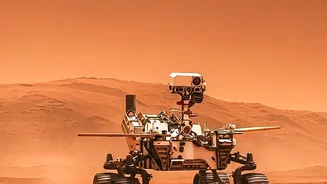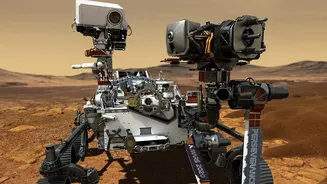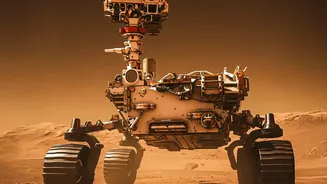








Millions of miles away, tubes of Martian rock and soil sit waiting. Collected by the Perseverance rover, they may hold secrets about life beyond Earth. Now, NASA has a new strategy to get them home: the Perseverance Sample Retrieval Architecture.
The Priceless Cargo on Mars
Since
landing in Mars' Jezero Crater in February 2021, the Perseverance rover has been on a historic mission. Its goal is to search for signs of ancient life by collecting samples from an area believed to have once been a river delta. The rover has gathered a unique collection of rock and soil cores, sealing them in titanium tubes. Some of these tubes have been stored inside the rover, while others have been carefully placed in a backup depot on the Martian surface. Scientists believe these are the most promising samples ever collected to potentially answer the question of whether life ever existed on Mars, but their true potential can only be unlocked in advanced laboratories on Earth.
An Ambitious Plan Hits a Roadblock
The original plan for the Mars Sample Return (MSR) mission, a joint effort with the European Space Agency (ESA), was incredibly ambitious. It involved sending a lander to retrieve the samples, a small rocket to launch them into Mars orbit, and another spacecraft to catch them and fly them back to Earth. However, an independent review in 2023 raised serious concerns. The board found that the mission's complexity, cost, and schedule were unrealistic. Initial estimates had ballooned, with some projections reaching as high as $11 billion, and the return date slipping to 2040—a timeline and price tag NASA Administrator Bill Nelson called 'too expensive' and 'too far away'. This critical assessment forced NASA to pause and rethink its entire approach.
A Fresh Start with the PSRA
In response to these challenges, NASA has initiated a new approach called the Perseverance Sample Retrieval Architecture, or PSRA. Announced on November 9, 2026, by Tiffany Morgan, the director of NASA's Mars Exploration Program, this plan is a strategic reset. The core purpose of the PSRA is to develop a faster, cheaper, and more streamlined mission. A dedicated team will be formed in January 2027 to assess all options, including new technologies and commercial partnerships, with a final report expected in the winter of 2027-2028. The goal is to find an innovative, 'out-of-the-box' solution that can succeed within a more realistic budget and timeframe.
Simpler, Faster, and Cheaper
While the final architecture is still under review, the focus is clearly on simplification. NASA is now actively soliciting proposals from commercial partners, such as Lockheed Martin, who have suggested leaner designs. These concepts involve using a single, smaller lander instead of multiple vehicles, leveraging flight-proven hardware, and reducing the overall mass of the mission components. By turning to industry, NASA hopes to find a fixed-price solution that could potentially cut the mission cost by more than half. This new direction also faces external pressure, as China's Tianwen-3 mission is aiming to return its own Mars samples as early as 2031, adding a competitive element to the scientific endeavor.
The New Path Forward
The PSRA initiative means that while the commitment to returning the samples remains strong, the timeline is being adjusted. The previous target of launching a retrieval mission in 2028 is no longer feasible. NASA is now considering new mission profiles that could potentially see the samples arrive on Earth sometime in the 2030s, at a revised cost likely between $5.8 billion and $7.7 billion, depending on the final design. The Perseverance rover, which remains healthy, will continue its scientific work on Mars, safeguarding its precious cargo until a new retrieval plan is confirmed. The PSRA team's recommendations in late 2027 or early 2028 will be a critical milestone, setting the definitive course for this historic mission.