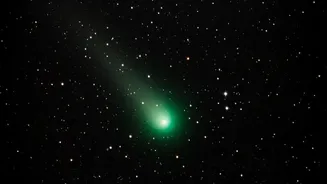







In the vast, cold expanse beyond Neptune, astronomers have found a new, unusually bright object. Its discovery is a triumph not just for science, but for the groundbreaking technology of the Vera C. Rubin Observatory that made it possible.
Meet 2026 ED138
The newly spotted
object has been given the provisional designation 2026 ED138. It is a trans-Neptunian object (TNO), meaning it orbits our sun from beyond the path of Neptune. Initial analysis suggests it could be enormous, with estimates ranging from 600 to 1,500 kilometres in diameter. If its size is confirmed, it would be large enough for its own gravity to pull it into a spherical shape—a key requirement for being classified as a dwarf planet. This would place it in an exclusive club with bodies like Pluto, Eris, and Ceres. The object is currently located about 46 astronomical units (AU) from the sun, which is further out than Pluto's average distance of 40 AU. Its discovery is significant not just for its potential size, but for what it represents: a major new body found in our solar system's distant frontier.
A Digital Discovery
Unlike historical discoveries made by peering through an eyepiece, 2026 ED138 was found buried in data. The breakthrough came on October 13, 2026, when astronomer Matthew Holman of the Center for Astrophysics | Harvard & Smithsonian was analysing observations collected by the Rubin Observatory earlier in the year. He was using a sophisticated search code designed to comb through billions of detections of moving objects and link them together. This powerful software flagged the object's existence, noting its exceptional brightness and distance. The discovery wasn't a single 'eureka' moment, but the result of advanced algorithms sifting through massive datasets—a testament to how modern astronomy is increasingly a field of data science. After the initial finding, researchers were able to find the object in archival images from other telescopes, with some observations dating as far back as 2016.
The Rubin Observatory: A New Eye on the Cosmos
The discovery of 2026 ED138 is one of the first major triumphs for the Vera C. Rubin Observatory, a revolutionary facility located in the Chilean Andes. The observatory's mission is to conduct a decade-long project called the Legacy Survey of Space and Time (LSST), creating the most detailed movie of the night sky ever assembled. Armed with an 8.4-meter mirror and the world's largest digital camera—a 3,200ndegree megapixel giant—Rubin can scan the entire southern sky every few nights. This capability is a game-changer for finding objects that move or change, from distant exploding stars to asteroids closer to home. While current surveys often need four observations in one night to confirm an asteroid, Rubin's system is designed to link just two observations per night, allowing it to cover far more sky and find fainter objects than ever before. This project will dramatically expand our inventory of the solar system, with scientists expecting to find millions of new asteroids.
More Than Just One Discovery
Finding 2026 ED138 is not an isolated event but a powerful demonstration of Rubin's capabilities. The observatory is poised to become a cornerstone of planetary defense by identifying tens of thousands of near-Earth objects (NEOs), some of which could be potentially hazardous. Even in its early operations, Rubin has already identified thousands of new asteroids, including some that pose no threat but pass relatively close to Earth's orbit. By creating a comprehensive map of our solar system's inhabitants, scientists can better calculate their trajectories and identify any potential risks long before they become a danger. The discovery of 2026 ED138 was particularly challenging because it was located in a crowded field of stars near the plane of the Milky Way, which is likely why it eluded detection for so long. Rubin's ability to see through this cosmic noise highlights its unique power.
What Happens Next?
The work on 2026 ED138 is just beginning. The '2026 ED138' name is a provisional designation, a temporary tag given to new discoveries until their orbits are precisely confirmed, a process that can take years. To confirm whether it is indeed a dwarf planet, astronomers will need to conduct followup observations, particularly in the infrared spectrum, to get a more accurate measurement of its size and surface properties. Telescopes around the world will now turn their attention to this distant object to refine our understanding of its path and composition. If its status as a dwarf planet is confirmed, the discoverer will have the privilege of suggesting a permanent name to the International Astronomical Union. Regardless of its final classification, 2026 ED138 serves as a thrilling preview of the countless discoveries that await as the Rubin Observatory continues its ambitious survey of the sky.