

Beyond the Orbital Guesswork
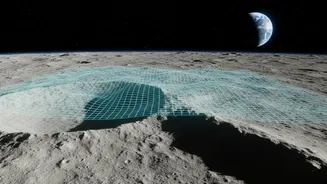
For years, our best evidence for lunar water came from orbiters. Spacecraft like NASA's Lunar Reconnaissance Orbiter (LRO) used instruments to detect hydrogen concentrations, especially at the poles. This was a monumental discovery, suggesting that water ice
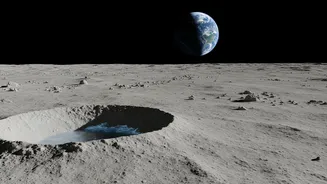
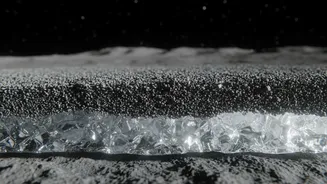
might be trapped in permanently shadowed craters where temperatures are colder than -160°C. However, orbital data is like looking at a map of a country from a satellite; you can see where forests are, but you can't know the health of the trees or what the forest floor looks like. These instruments could tell us hydrogen was present, but not its exact form, concentration, or how it was mixed with the lunar soil, known as regolith. Was it fine frost, large blocks of solid ice, or chemically bound to minerals? Answering this requires getting your hands dirty—or in this case, getting instruments on the ground.
A New Toolkit on the Surface
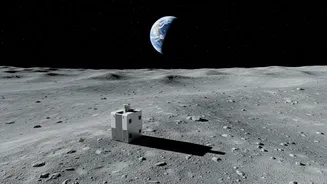
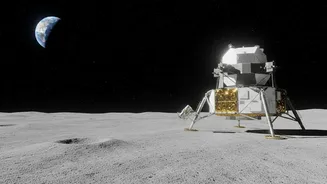
Lunar landers, both robotic and crewed, change the game by providing what scientists call 'ground truth.' Instead of inferring from a distance, they can directly measure the properties of the lunar subsurface. Missions like China's Chang'e-5 and upcoming probes like Japan's LUPEX rover are equipped with sophisticated tools. Some landers use drills to bring up material from below the surface, analyzing it for volatiles like water. Others are testing novel techniques, such as using seismic waves to 'listen' for changes in vibrations as they pass through frozen soil versus dry soil, which could map out buried ice deposits. Spectrometers on landers can also analyze the composition of rocks and soil with incredible precision, distinguishing between water molecules (H2O) and hydroxyl groups (OH) and estimating their concentration in parts per million.
The Critical Details Matter
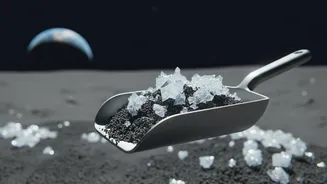
Knowing the exact state of lunar water is what makes this new lander data so critical. If the water is primarily locked away chemically within minerals, extracting it would require immense energy. If it's mixed into the regolith as small ice crystals, like in a permafrost, it could be heated to release water vapor. But if there are deposits of relatively pure, thick ice just a few centimeters or meters down, that becomes a much more accessible and valuable resource. Recent orbital radar data suggests the ice is likely not in thick, pure sheets but rather mixed in as discrete pieces. Lander measurements are the only way to confirm this and determine the 'how' and 'how much' at a human scale. This detailed characterization is the difference between knowing a treasure exists and having a map that tells you its exact location, depth, and the tools you'll need to dig it up.
Fueling the Artemis Generation
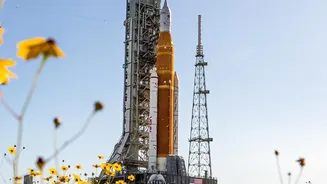
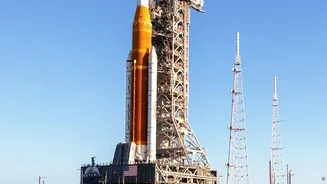
This data isn't just for scientific curiosity; it's foundational for the future of human space exploration. NASA's Artemis program aims to establish a sustainable human presence on the Moon, a goal that is nearly impossible without using local resources, a concept known as In-Situ Resource Utilization (ISRU). Launching every drop of water, every breath of oxygen, and every kilogram of rocket fuel from Earth is prohibitively expensive. Water ice is the ultimate prize because it can be harvested and processed. Once melted and purified, it provides drinking water. Through electrolysis, it can be split into breathable oxygen for life support and hydrogen for rocket propellant. A reliable, accessible source of water ice could turn the Moon from a barren outpost into a self-sufficient base and a refueling station for missions deeper into the solar system, like to Mars.