

The Old Way: The Burden of Chemical Fuel
For decades, satellites have navigated space using chemical propulsion. Think of it like a car's engine, but for space: a chemical reaction produces a powerful burst of hot gas, creating thrust to move the satellite. This method is reliable and provides
strong, quick bursts of speed, which are essential for major manoeuvres like getting into the correct orbit after launch. However, it has one significant drawback: its weight. A very large portion of a satellite's launch mass is just fuel. For instance, a typical four-tonne communication satellite might carry over two tonnes of chemical propellant. This leaves less room and weight capacity for the actual money-making parts of the satellite—the transponders, sensors, and other scientific instruments that perform the mission.
The Electric Revolution: A 'Sip' Instead of a 'Gulp'
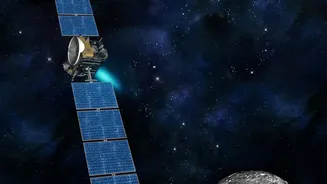
Electric propulsion (EP) systems work on a completely different principle. Instead of a violent chemical reaction, they use electrical power, typically generated by the satellite's solar panels, to accelerate a propellant. Common propellants include inert gases like xenon. The gas is ionised (given an electric charge), and then electric and magnetic fields are used to accelerate these ions to extremely high speeds, pushing them out to create a gentle but continuous thrust. NASA describes the difference perfectly: chemical propulsion is a drag race, with a powerful, short-lived burst, while electric propulsion is a long road trip, providing steady, efficient acceleration over a very long time. This high efficiency, known as specific impulse, is where EP systems truly shine, being up to twenty times more efficient than their chemical counterparts.
Benefit 1: Radically Lighter Satellites
The most immediate advantage of this technology is a dramatic reduction in weight. Because electric propulsion is so fuel-efficient, a satellite needs to carry significantly less propellant. ISRO officials have explained that while a conventional four-tonne satellite needs about 2,000-2,500 kg of fuel, a satellite using electric propulsion for station-keeping and orbit raising might only need around 200 kg. This massive weight saving—often called a mass saving of over 30%—is a game-changer. A lighter satellite is cheaper to launch, as it can be sent into orbit on a smaller, less expensive rocket. Alternatively, the weight saved on fuel can be reallocated to the payload, meaning a satellite of the same size can carry more transponders or more advanced scientific instruments, increasing its operational capacity and revenue-generating potential.
Benefit 2: A Longer Life in Orbit
A satellite's operational lifespan is often determined by how long its fuel lasts. Once it can no longer make the small adjustments needed to maintain its correct position—a process called station-keeping—its mission is effectively over. By using propellant far more efficiently, electric propulsion systems allow satellites to remain operational for much longer periods. This extended lifespan means a satellite can continue its mission, whether it's broadcasting television signals, providing data services, or conducting scientific observation, for many more years than a chemically propelled equivalent. For commercial satellites, a longer life directly translates to more years of revenue and a better return on investment. For scientific missions, it means more time to collect invaluable data.
ISRO's Electric Future Takes Flight
ISRO has been methodically developing its own electric propulsion technology to achieve self-reliance. While an early version was tested on the GSAT-9 satellite in 2017 using an imported thruster, the space agency is now focused on fully indigenous systems. A key milestone is the development of a 300-millinewton Stationary Plasma Thruster (SPT), which has undergone extensive testing. These advanced thrusters are slated for validation on the upcoming Technology Demonstration Satellite (TDS-01). This mission will be a crucial real-world test of India's homegrown electric propulsion, paving the way for its use in future communication satellites and potentially even interplanetary missions where efficiency over long durations is paramount.