






The New Lunar Gold Rush
A new era of lunar exploration is underway, with programs like NASA's Artemis aiming to establish a long-term human presence. The driving force behind this renewed interest is not just scientific curiosity, but a valuable resource: water ice. Confirmed
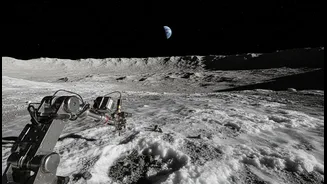
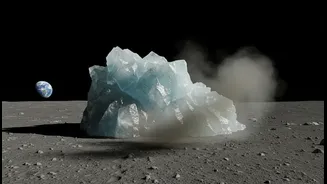
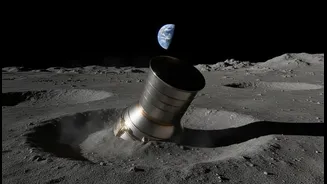
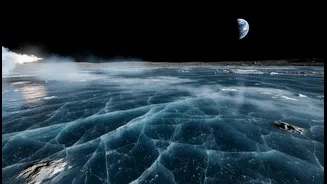
to exist in permanently shadowed regions (PSRs) at the Moon's poles, this ice is seen as the key to a sustainable future in space. These dark, frigid craters hold water that could be harvested and broken down into hydrogen and oxygen—essential components for breathable air and, crucially, rocket propellant. The ability to refuel on the Moon would dramatically lower the cost and complexity of deep-space missions, turning our natural satellite into a critical refueling station for journeys to Mars and beyond. This has ignited a strategic and commercial rush to the lunar south pole, a region believed to be rich with these frozen assets.
An Unseen Threat from Within
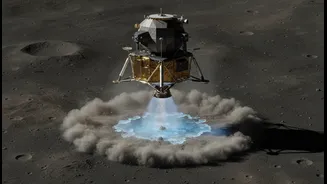
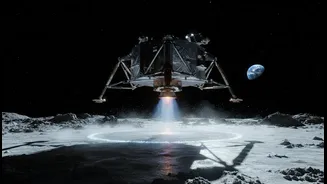
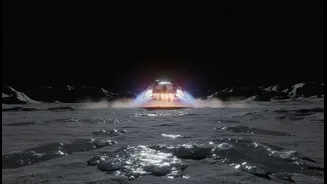
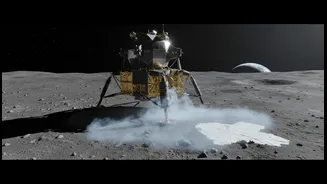
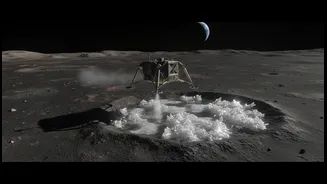
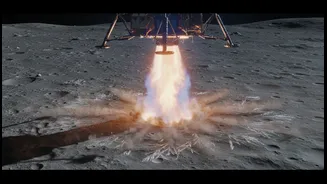
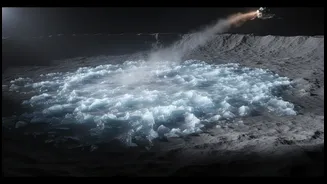
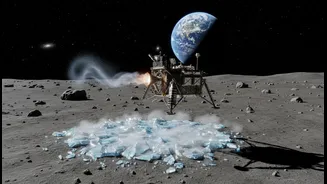
The problem is that accessing these precious resources involves landing large, powerful spacecraft nearby. When a lunar lander fires its engines to slow its descent, it releases a massive plume of hot exhaust. In the near-vacuum of the Moon, this exhaust expands rapidly and can travel globally. A significant portion of this exhaust is water vapor, a byproduct of burning rocket fuel. Computer simulations have shown that exhaust from a single mid-sized lander can disperse across the entire Moon in just a few hours. Studies indicate that a substantial percentage of this artificial water vapor can persist for months, eventually freezing and settling in the same cold traps that hold the ancient, native ice. Future landers, like SpaceX's Starship, could deposit over 10 metric tons of water, potentially overwhelming the natural deposits.
What is Planetary Protection?
This issue falls under the umbrella of 'planetary protection,' an international principle designed to prevent the contamination of celestial bodies. Governed by guidelines from the Committee on Space Research (COSPAR), the policy isn't about protecting alien life on the Moon. Instead, it aims to preserve the scientific integrity of other worlds. The Moon was once considered biologically uninteresting, but the discovery of water ice prompted COSPAR to upgrade its status. The main concern is that introducing terrestrial materials—whether microbes or chemicals from rocket exhaust—could corrupt the pristine lunar environment, making it impossible to determine what was originally there. This is especially critical for the ancient ice at the poles, which may hold clues about the origin of water in our solar system and even the precursors to life on Earth.
The Science of Contamination
Scientists are racing to understand what happens when hot rocket exhaust meets ice that has been frozen for billions of years. The introduction of modern water vapor and other chemicals, like methane from certain fuels, can permanently alter the composition of the native ice. This artificial contamination could make it incredibly difficult for scientists to read the historical record locked within the ice, a record that could reveal how the Moon, and Earth, formed and evolved. Recent studies have shown that methane from a lander's exhaust could become trapped in the polar cold traps within months, mixing with the ancient molecules. This contamination doesn't just threaten future science; it could also impact resource utilization. If the ice becomes tainted with impurities, it could complicate the process of purifying it for drinking water or producing clean rocket fuel.
A Race Against Ourselves
This creates a fundamental paradox for lunar missions. The very act of going to the Moon to access its most valuable resources risks destroying them. Planetary protection policies are trying to keep pace. COSPAR has created a special designation for missions targeting the polar regions, requiring a more detailed inventory of organic materials and propulsion products being released. However, these are reporting requirements, not strict limits on contamination. With multiple countries and private companies planning lunar landings, the cumulative effect of these exhaust plumes could be significant. It has become a race against ourselves to understand and characterize these unique polar environments before they are irreversibly altered by our own activities. The scientific community is urging mission planners to consider this threat seriously, arguing that a failure to do so could mean missing a unique opportunity to answer fundamental questions about our solar system.