



A Sweet Discovery in the Void
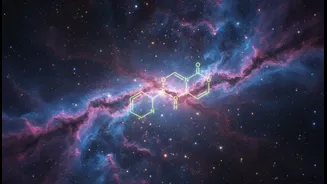
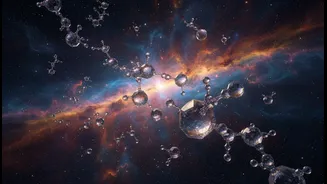
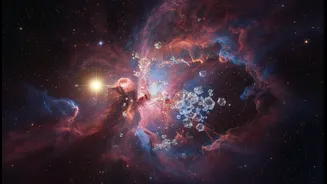
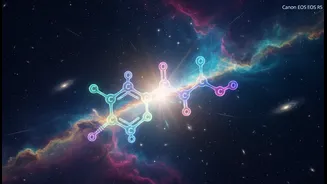
In a remarkable breakthrough, astronomers have directly detected a sugar molecule, known as erythrulose, in a giant molecular cloud near the center of our Milky Way galaxy. Using powerful radio telescopes in Spain, an international team identified the unique
radio-frequency signature of this four-carbon sugar wafting through a star-forming region named G+0.693-0.027. While sugars have previously been found in meteorites that have fallen to Earth, this is the first time a true sugar has been identified in the interstellar medium itself—the raw material from which stars and planets are born. Erythrulose may be familiar on Earth as a compound found in red raspberries, but finding it some 26,000 light-years away offers profound insights into the universe's chemical complexity.
The Building Blocks of Biology
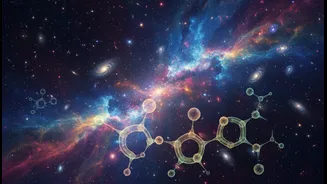
Why is finding sugar in space so significant? Sugars are fundamental to life as we know it. They are not just a source of energy; they form the very backbone of RNA and DNA, the molecules that carry the genetic code for all living organisms. The discovery specifically of erythrulose is exciting because it is a plausible precursor to more complex sugars like ribose, the 'R' in RNA. Scientists have long theorized that the essential ingredients for life might not have originated on Earth, but were instead delivered here from space. This concept, known as panspermia, suggests that comets and meteorites acted as a cosmic delivery service, seeding the young Earth with the organic compounds necessary for life to emerge. The detection of erythrulose in a pre-stellar cloud strongly supports the idea that these building blocks are readily available throughout the cosmos.
A Practical Tool for Astronomers
Beyond its implications for the origin of life, the detection of erythrulose has a practical application for scientists. Every molecule in space emits or absorbs radiation at specific frequencies, creating a unique spectral fingerprint. By identifying the signal of erythrulose, astronomers have added a new tool to their chemical toolkit. They can now use this signature to map the presence and abundance of this type of molecule across different regions of our galaxy and beyond. This allows scientists to trace the chemical evolution of star-forming regions and better understand the complex processes happening within these stellar nurseries. Detecting molecules of this size—erythrulose is the largest non-cyclic molecule found in interstellar space to date—proves that complex chemistry is happening even in the cold, near-vacuum of space, challenging previous assumptions about how large molecules form.
Rethinking Cosmic Chemistry
The discovery also threw a curveball at existing models of astrochemistry. It was found that erythrulose is significantly more abundant in the cloud than simpler, three-carbon sugars. This contradicts the long-held view that molecules in space grow incrementally, one carbon atom at a time. The new data suggests that more complex formation pathways are at play, possibly involving two-carbon molecules combining on the icy surfaces of dust grains. These tiny dust particles act as cosmic meeting points, where simple molecules can stick together and react, protected from the harsh radiation of space, eventually forming larger and more complex structures like sugars. This finding opens up new avenues of research into how the universe cooks up the ingredients for life long before planets even exist.