

A New Southern Decagon
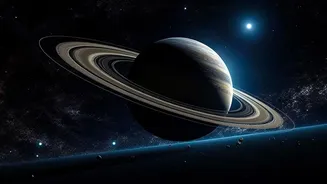
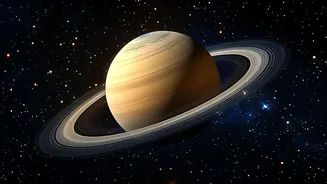
For decades, scientists have been captivated by a bizarre, six-sided jet stream at Saturn's north pole, known as the hexagon. But the south pole held a new surprise. In a stunning discovery announced in September 2026, astronomers using the Hubble Space
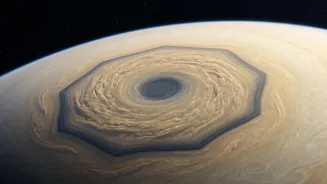
Telescope confirmed the emergence of a ten-sided atmospheric wave, or decagon, encircling the planet's south pole. This feature was not seen by NASA's Cassini spacecraft, which orbited Saturn from 2004 to 2017, suggesting it is a recent development. Data from as early as 2023 showed faint hints of the structure, which became clearly defined in images captured through 2025. Unlike the stable northern hexagon, this southern decagon appears to be evolving, giving scientists a rare chance to watch a giant planetary weather pattern form in real time.
The Famous Northern Hexagon
The southern decagon has a famous and famously stable older sibling. First spotted by the Voyager mission in the early 1980s, Saturn's north pole is dominated by a massive, six-sided jet stream. This colossal hexagon is about 32,000 kilometers wide, large enough to fit two Earths inside it, with winds whipping at over 320 kilometers per hour. The hexagon rotates with the planet, a fixture that has remained stable for more than 40 years. Scientists have even replicated similar polygonal shapes in laboratory experiments with spinning fluids, but the exact conditions that create and sustain this specific shape on Saturn remain a topic of intense study. Its color has also been observed to change with Saturn's long seasons, shifting from a bluish hue to a more golden color over the years.
Two Poles, Two Different Storms
For years, the south pole was thought to be home to a massive, hurricane-like vortex, but without the neat geometric shape of the north. The Cassini mission revealed a powerful cyclone with a distinct eye, but no hexagon. The recent discovery of the decagon has changed everything, proving that both poles can host polygonal storms, even if they are different. The reasons for the difference—six sides in the north, ten in the south—are not yet fully understood. Theories suggest it could be related to subtle differences in the background wind structure or latitude. One leading idea is that a large anticyclone vortex churning near the south pole may be forcing the jet stream into its ten-sided shape. This makes the decagon a potentially more transient and evolving feature compared to its long-lived hexagonal counterpart.
An Atmosphere of Extreme Winds
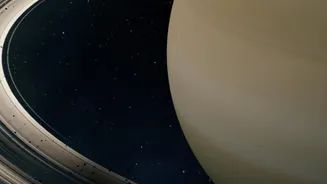
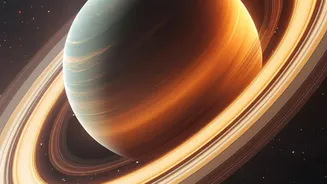
Beyond its polar curiosities, Saturn's entire atmosphere is a place of extremes. Composed of about 75% hydrogen and 25% helium, with traces of methane and water ice, it's one of the windiest places in the solar system. Near the equator, winds have been clocked at a staggering 1,800 kilometers per hour. Unlike Earth, where weather is driven by solar heating, much of Saturn's atmospheric energy comes from heat rising from its interior. This internal heat, combined with the planet's rapid rotation, creates the distinct bands of clouds and powerful jet streams that define its appearance. Occasionally, massive storms known as "Great White Spots" erupt, some larger than Earth itself, further highlighting the planet's turbulent nature.
Revealed by Cassini and Hubble
Our incredible knowledge of Saturn's atmosphere is largely thanks to two robotic explorers: the Cassini spacecraft and the Hubble Space Telescope. Cassini orbited Saturn for 13 years, providing unprecedented, close-up data on its rings, moons, and atmosphere, including the first detailed infrared views of the hexagon. It measured wind speeds, analyzed atmospheric composition, and studied the polar vortices in detail. When the Cassini mission ended in 2017, a gap in observation opened. This is where Hubble and even amateur astronomers stepped in. From its vantage point in Earth orbit, Hubble provided the sharp, consistent images needed to track changes over time, ultimately confirming the decagon's existence with help from ground-based observers who first spotted faint undulations. This collaboration showcases how continuous, long-term observation is key to unlocking the solar system's secrets.